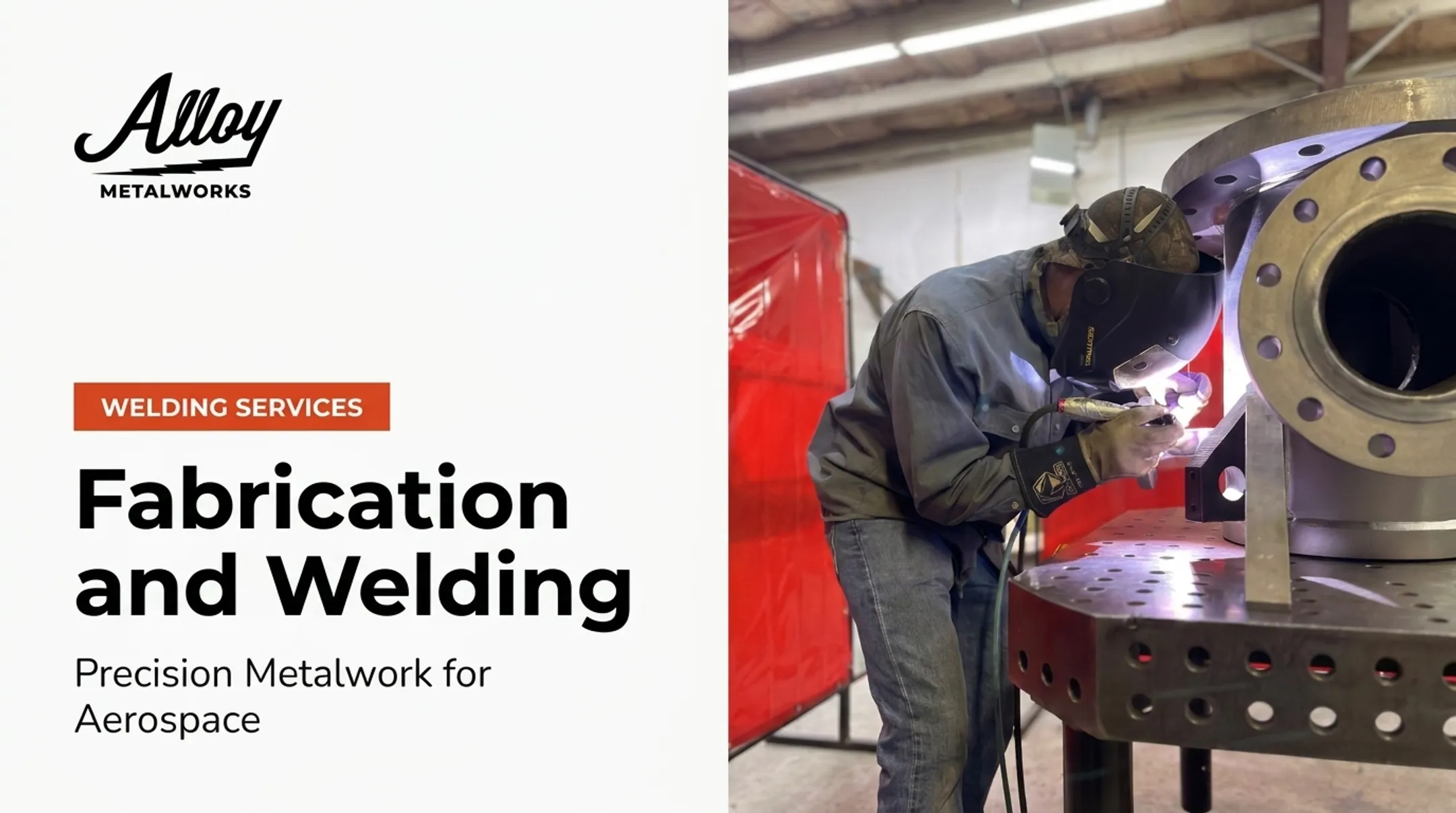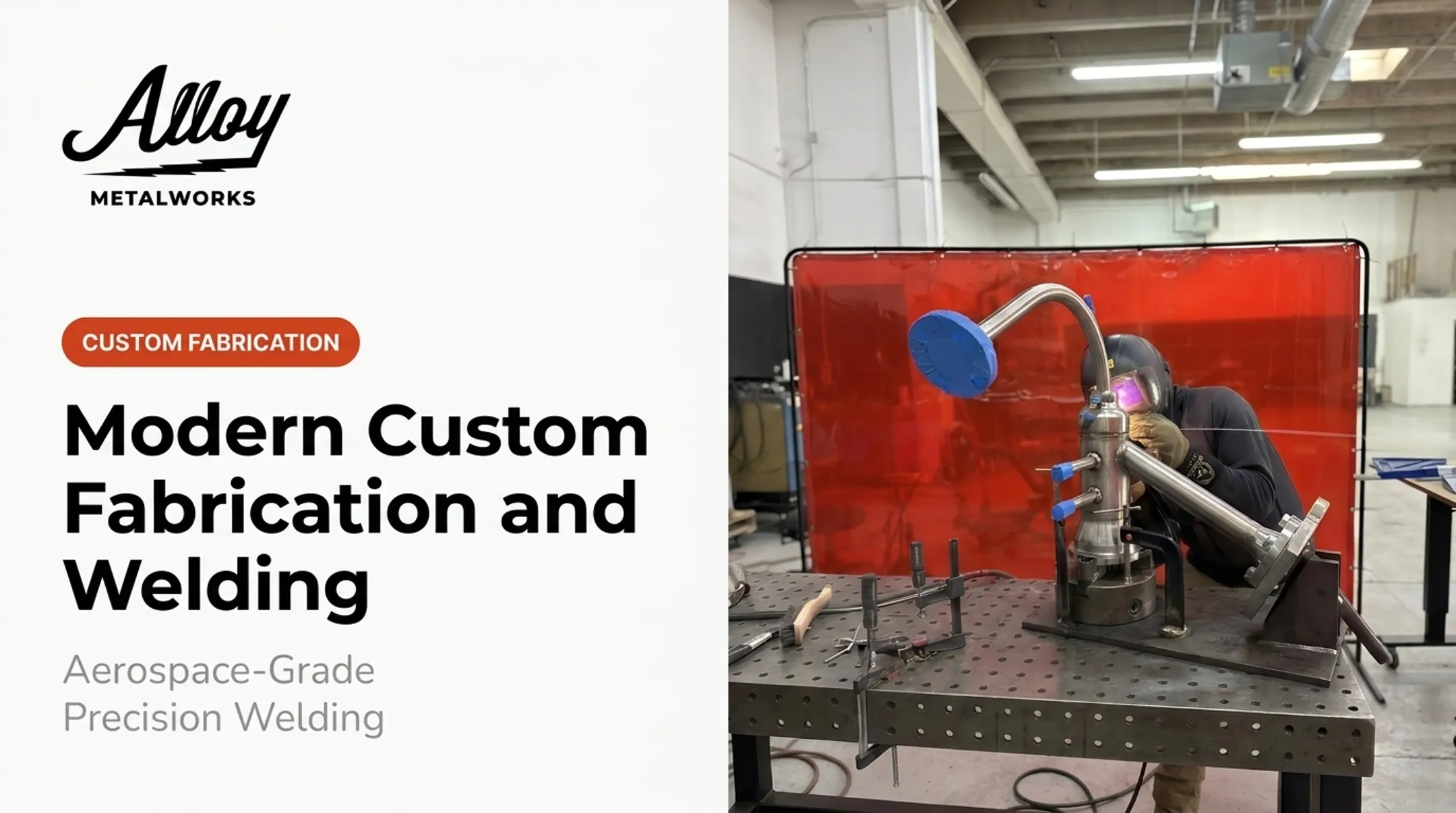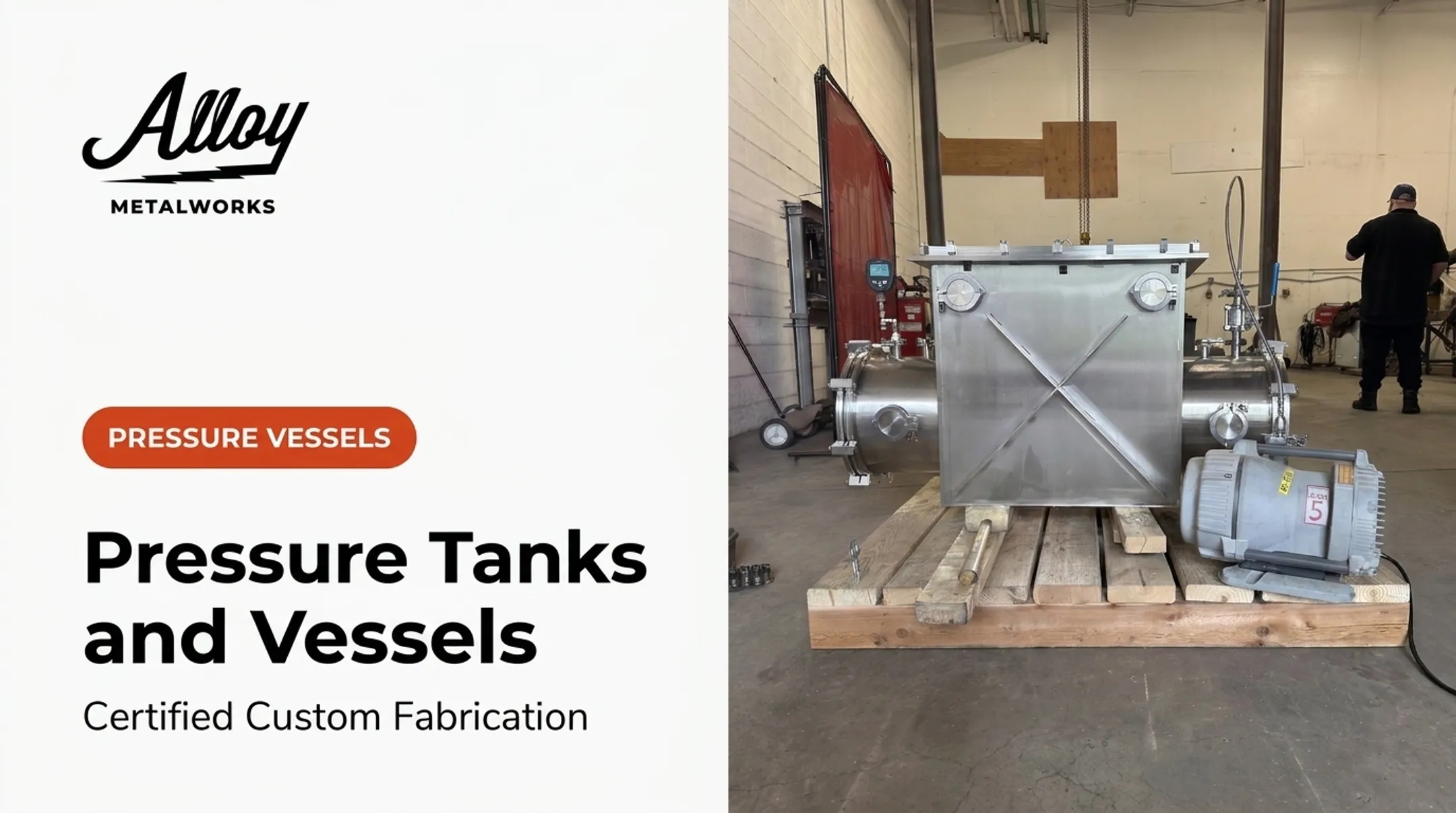

Yet many buyers and engineers struggle with the vocabulary: WPS, PQR, weld positions, joint types. These terms matter because they determine whether a fabrication partner can actually deliver a compliant part, not just a good-looking one.
This guide covers welding types, welded assembly fundamentals, the codes that govern quality, joint anatomy, and how to vet a welding partner for demanding, regulated work.
Key Takeaways
- Welded assemblies create a permanent metallurgical bond, offering superior strength and leak-tight integrity versus bolts or rivets
- Process choice matters: MIG, TIG, Stick, and flux-cored each fit different materials, thicknesses, and environments
- WPS and PQR prove a welding procedure is qualified and repeatable: non-negotiable for ASME/AWS code work
- Correct code and position selection directly affects structural integrity in flight-critical or sanitary hardware
- A certified, code-compliant partner cuts inspection failures, rework, and compliance risk on qualified work
What Are Welded Assemblies and Why They Matter
A welded assembly is two or more fabricated metal components joined into a single structure through fusion welding. Unlike bolting or riveting, welding fuses the metals into one continuous bond instead of a mechanical connection point.
The typical production flow looks like this:
- Cut and form raw material into components
- Fixture parts into precise alignment
- Weld per a qualified procedure
- Inspect for dimensional tolerance and weld soundness

Industries that depend on welded assemblies include:
- Aerospace ground support structures and flight-critical hardware
- Hydrogen and fuel cell systems
- Sanitary process equipment for food, beverage, and pharma
- Chemical reactors and pressure vessels
In these settings, early engineering collaboration prevents expensive redesigns later. Alloy Metalworks builds that into the process: weld-joint design support, heat-input and distortion control, and contamination-risk mitigation happen at the design stage, not after a part fails inspection.
Traceability matters as much as the weld itself. Welding needs continuous process control because you cannot fully verify every joint after the fact; you can't cut open each weld to check it.
ISO 9001-controlled documentation that links material heat lot, WPS, welder, and inspection records is what actually protects a buyer in regulated sectors.
Types of Welding Processes Used in Assemblies
Four arc welding processes form the foundation of nearly all fabrication work: MIG (GMAW), TIG (GTAW), Stick (SMAW), and Flux-Cored (FCAW).
MIG, TIG, Stick, and Flux-Cored Compared
| Process | Best For | Notes |
|---|---|---|
| MIG (GMAW) | Carbon and stainless steel structural work | Continuous wire electrode plus shielding gas; fast and production-friendly |
| TIG (GTAW) | Thin-gauge stainless, aluminum, titanium, Inconel | Precision arc process; often needs controlled purge setups |
| Stick (SMAW) | Structural and outdoor/field repair work | Rugged, portable, less sensitive to wind or dirty conditions |
| Flux-Cored (FCAW) | Medium-to-heavy structural or outdoor fabrication | Tubular wire with flux core; self-shielded or gas-shielded variants |
Specialty alloys demand more. Welding Inconel, Incoloy, Hastelloy, or titanium isn't standard sheet metal work. It requires precise heat control, careful surface preparation, and procedures built to preserve mechanical properties.
Titanium is particularly unforgiving. Purple or blue discoloration on a finished weld can trigger a visual failure under AWS D17.1 Class A, even when the joint tests fine mechanically. Contamination during welding can embrittle the metal without any obvious defect until later inspection.
Alloy Metalworks addresses this with custom inert gas chambers and purge setups purpose-built for titanium and nickel-based superalloys like Inconel 600, 625, 718, and Incoloy 800HT, where heat input and shielding leave little margin for error.

Codes, Standards, and Weld Qualification Documentation
Weld quality isn't judged by eye. It's governed by specific codes matched to material and application:
- AWS D1.1 – Structural steel
- AWS D1.2 – Structural aluminum
- AWS D1.6 – Structural stainless steel
- AWS D17.1 – Aerospace fusion welding
- AWS D18.1 – Sanitary stainless steel tube and pipe systems
- ASME Section IX – Procedure and welder qualification for pressure-retaining equipment
WPS and PQR: The Documentation Backbone
A Welding Procedure Specification (WPS) is the written instruction set for producing a compliant weld: process, filler metal, amperage, position, and more. A Procedure Qualification Record (PQR) is the tested proof that following that WPS actually produces a sound weld. A Welder Qualification Test Record (WQTR) adds a third layer: verification that the individual welder, not just the procedure, can execute the work to code. Together, WPS, PQR, and WQTR form the paper trail inspectors expect before a weld is accepted. Why this matters in practice: During a piping-system rebuild, Alloy Metalworks discovered that a previous contractor's welds failed inspection because documentation was missing entirely: no weld records, no procedure qualification, no welder qualification. The rebuild required ASME B31.3 visual inspection, in-house borescope and dye-penetrant testing, and certified third-party magnetic-particle testing to bring the system back into compliance. Inspection methods vary by requirement:
- Visual inspection (baseline for nearly all welds)
- Dye-penetrant testing (surface-breaking defects)
- Radiographic or magnetic-particle testing (internal defects, code-mandated for critical joints) For flight-critical hardware, FAA Part 145 Certified Repair Station status adds another oversight layer, but it only covers the specific tasks listed on that repair station's certificate, not blanket authorization for any weldment.
Anatomy of a Weld and Joint Design
Understanding weld terminology helps buyers read a drawing or inspection report intelligently:
- Base metal – the material being joined
- Weld bead – deposited filler metal from a single pass
- Heat-affected zone (HAZ) – base metal altered by heat but not melted
- Weld face – the visible surface of the completed weld
- Weld toe – the edge where the weld face meets base metal
- Weld root – the deepest point of the joint
The five basic joint types:
- Butt joint – ends aligned in the same plane; often a groove weld
- Lap joint – overlapping plates; commonly a fillet weld
- Tee joint – members meet at a right angle; typically a fillet weld
- Corner joint – edges form a corner; fillet or groove depending on access
- Edge joint – parallel edges joined; used on thin sections and flanges

Joint geometry directly affects arc access and weld quality. A tee joint might use a fillet weld while a butt joint calls for a groove weld — the joint type and weld type aren't the same thing.
HAZ size and joint design matter most on thin stainless, titanium, and nickel alloys, where distortion risk is highest and rework margin is thin.
Welding Positions and Skill Considerations
Position affects everything: deposition rate, defect risk, and welder skill required.
The four standard positions:
- Flat (1F/1G) — highest deposition, lowest defect risk, baseline skill
- Horizontal (2F/2G) — moderate puddle control; gravity pulls across the joint
- Vertical (3F/3G) — uphill or downhill technique to manage runoff
- Overhead (4F/4G) — hardest orientation; molten metal wants to fall from the puddle
Overhead is the hardest position. Gravity pulls molten metal downward rather than helping it stay put, and access and visibility are usually worse than in any other orientation. Vertical work ranks close behind: you still fight runoff, with less room for travel-speed error.

Flight-critical and pressure-vessel work often requires welders certified in multiple positions to satisfy the invoked code. Real-world assemblies rarely let you weld everything flat.
Choosing a Qualified Welding and Fabrication Partner
Picking a partner for aerospace, energy, or sanitary work means verifying certifications, not just years in business.
Questions to ask any prospective partner:
- Can they produce current WPS and supporting PQR for the exact alloy and joint type?
- Do welder qualification records (WQTR) exist for the people doing the work?
- Have they welded this specific alloy before: Inconel, titanium, Hastelloy?
- Can they support you from prototype through production volume?
- What documentation and traceability accompany the finished part?
Alloy Metalworks, based in Colorado, holds ISO 9001 QMS, ASME Section IX, AWS D17.1 Class A, AWS D18.1, AWS structural codes (D1.1, D1.2, D1.6), and FAA Part 145 QMS accreditation.
The shop has fabricated Incoloy chemical reactor systems, aerospace ground support structures, and aluminum TIG welds that passed radiographic and macroscopic evaluation for aerospace customer Fortius Metals.
Engineering collaboration up front, code-compliant execution, and inspection-ready documentation at delivery are what prove a shop can stand behind its certifications.
Frequently Asked Questions
What are the four types of welding?
The four foundational arc welding processes are MIG (GMAW), TIG (GTAW), Stick (SMAW), and Flux-Cored (FCAW). MIG suits fast production work, TIG handles precision and thin-gauge or exotic alloys, and Stick and Flux-Cored work well for rugged structural or field applications.
What are welding assemblies?
A welded assembly is a structure of multiple fabricated metal components joined through fusion welding. This creates a continuous metallurgical bond rather than a mechanical connection like bolts or rivets.
What are WPS and PQR?
A Welding Procedure Specification (WPS) is the documented instructions for making a compliant weld. A Procedure Qualification Record (PQR) is the tested proof that following that WPS actually produces a sound, code-compliant weld.
What are the parts of a weld called?
Key components include the weld bead, heat-affected zone (HAZ), weld face, toe, and root. The fusion zone refers to the base metal that actually melted and re-solidified during welding.
What is the hardest position in welding?
Overhead welding is the hardest position. Gravity pulls the molten pool downward, and welders often have limited visibility and access. Vertical welding is a close second.