
This guide breaks down insulation types, material selection, vacuum jacketed systems, and why fabrication quality determines whether your insulation actually performs long-term.
Demand for this infrastructure isn't slowing down. US hydrogen production sits around 10 million metric tons per year, with the National Clean Hydrogen Strategy targeting 50 MMT by 2050. LNG, aerospace, and industrial gas sectors are all expanding their cryogenic footprints alongside it.
Key Takeaways
- Cryogenic insulation must block heat transfer via conduction, convection, and radiation, plus include a functioning vapor barrier
- Vacuum jacketed piping (VJP) remains the industry standard for high-performance cryogenic transfer lines
- Material selection and weld quality directly determine whether an insulation system holds up over time
- A certified fabrication partner reduces the risk of field failures, rework, and failed inspections
What Is Cryogenic Piping Insulation and Why It Matters
Cryogenic piping insulation is a system of materials and methods designed to prevent heat from entering pipes carrying fluids typically below -150°C (-238°F). NIST defines cryogenic liquids by this same threshold, tied to normal boiling points below 123 K.
The stakes are higher than typical insulation applications. Moisture that gets past the vapor barrier condenses inside the insulation layer, then drives corrosion under insulation (CUI). That failure mode is slow, destructive, and often undetected until a pipe wall is compromised.
What is cryogenic piping used for?
- LNG, LOX, LIN, LH2, and LAR transport and storage
- Regasification terminals
- Food and beverage processing
- Aerospace ground support equipment
What temperatures do these systems handle?
Typically below -150°C (-238°F). LNG lines run around -162°C (-260°F), while liquid hydrogen (LH2) drops to -253°C (-423°F) — colder than nearly any other industrial fluid in common use.
Types of Cryogenic Insulation Systems
Not every cryogenic application needs the same insulation approach. The right system depends on temperature range, budget, and how critical thermal performance is to the process.
Vacuum Jacketed Piping (VJP)
VJP uses a concentric design: an inner carrier pipe surrounded by an outer jacket pipe, with an evacuated annular space between them. Internal guides or spiders keep the two pipes centered without creating excessive heat bridges.
Despite higher upfront cost, VJP often delivers the best long-term value for reliable cryogenic transfer at scale. Manufacturer data shows heat-leak values as low as 0.32 BTU/hr/ft for smaller inner pipes, scaling up with diameter. It's the default choice for LNG, LOX, LIN, LH2, and LAR transfer lines.

Closed-Cell Foam and Polyisocyanurate Systems
For less extreme sub-zero applications, such as ammonia refrigeration, closed-cell PIR foam offers a simpler solution. Johns Manville's TRYMER PIR system lists a service range down to -183°C (-297°F), making it suitable for moderate cryogenic work but not for LNG or LH2 extremes.
Multi-Layer Insulation (MLI)
MLI uses alternating layers of reflective foil and spacer material under high vacuum. NASA testing shows this approach can achieve thermal conductivity as low as 0.01 to 1 mW/(m·K) under vacuum below 1 millitorr, far lower heat transfer than foam systems, but only in true high-vacuum conditions.
Pipe-in-Pipe / Containment Systems
Unlike VJP, some containment designs pressurize the outer jacket instead of pulling a vacuum. These trade some thermal efficiency for simpler maintenance and lower upfront installation complexity.
Vapor Barrier Membranes
Every insulation system needs a vapor barrier, regardless of the core insulation type. Zero-perm membranes are critical here. One tested product achieved a 0.0 perm rating by ASTM E96, but carried a low-temperature service limit of only -70°C (-94°F). A zero-perm rating alone does not mean the membrane is qualified for LNG or LH2 temperatures.
Quick comparison:
| System | Best For | Trade-off |
|---|---|---|
| VJP | LNG, LH2, LOX transfer | Higher upfront cost, best long-term performance |
| Closed-cell foam | Ammonia, moderate cryo | Limited to ~-183°C (-297°F) |
| MLI | Ultra-low temp, aerospace | Requires true high vacuum, sensitive to installation |
| Pipe-in-pipe | Simpler installations | Lower thermal efficiency than vacuum systems |

Selecting the Right Materials for Cryogenic Piping
Material choice is dictated by the cryogenic fluid, the temperature range, and the mechanical loads the system will see.
Austenitic Stainless Steel: The Standard
300-series stainless steel (304, 304L, 316) is the go-to for most demanding cryogenic ranges. It stays ductile at low temperatures where other metals become brittle. NIST maintains a cryogenic materials index covering these grades alongside aluminum alloys, Inconel 718, and Ti-6Al-4V.
Specialty Alloys for Extreme Conditions
- Inconel (600, 601, 617, 625, 718) — high-temperature and cryogenic-capable nickel alloys used in energy and aerospace systems
- Hastelloy and Incoloy 800HT — corrosion resistance in demanding chemical environments
- Titanium (Gr2, Gr7) — weight-sensitive aerospace applications, requires inert gas shielding during welding
- Aluminum (1000–7000 series) — lightweight cryogenic applications
Why doesn't carbon steel work? Standard carbon steel loses ductility and becomes brittle at cryogenic temperatures, making it prone to sudden fracture under stress. This is why austenitic stainless and specialty alloys dominate cryogenic piping specs.
Weld Integrity Matters as Much as Material Choice
You can spec the right alloy and still end up with a failure-prone system if the welds aren't right. Procedure qualification under ASME Section IX exists precisely because base material properties don't guarantee joint performance.
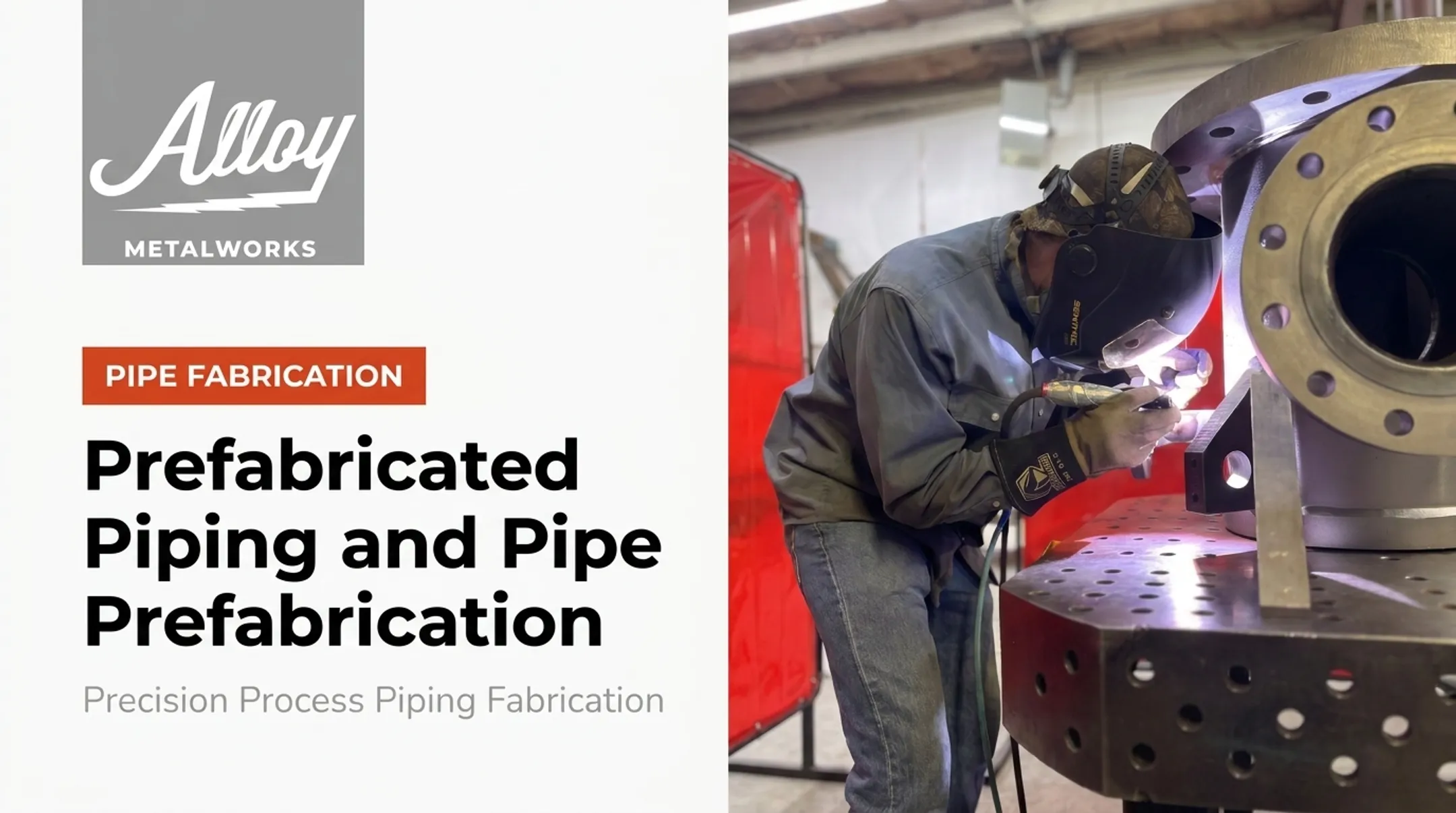
Alloy Metalworks welds Inconel, titanium, Hastelloy, and stainless steel under ASME Section IX and AWS D17.1 Class A. The Colorado shop uses custom inert gas chambers for precision titanium work, matching the control cryogenic and hydrogen energy systems require.

Key Considerations When Choosing an Insulation System
Four factors should drive your decision, in this order:
- Thermal efficiency: Check thermal conductivity ratings against your actual heat load calculations. Don't assume a manufacturer's spec sheet number applies directly to your installation conditions.
- Mechanical durability: Evaluate flexibility, moisture resistance, and whether the system can survive installation stress without compromising the vapor barrier.
- Installation and maintenance: Consider joint sealing complexity and whether inspectors can actually access the piping for future checks.
- Life-cycle cost: NASA research notes that less-strict vacuum requirements (like fiberglass-based systems) can offer manufacturing and life-cycle cost advantages, even if peak thermal performance is lower.
Installation quality isn't a minor detail either. NASA testing found that compression, seams, penetrations, and edge effects can increase MLI heat leak by 100% or more when poorly executed. The best-specified system on paper still fails in the field if installation cuts corners.
Common Challenges and Failure Points in Cryogenic Piping Systems
Differential Thermal Contraction
Core and jacket pipes contract at different rates as temperatures swing from ambient to cryogenic. This stresses welds and internal guides, particularly at contraction joints. A 2024 LNG Industry case study found vapor-barrier failures concentrated exactly at these mechanically stressed points.
Corrosion Under Insulation
Once a vapor barrier breaches, atmospheric moisture gets drawn in. It condenses, fills voids with ice or water, and gradually degrades both insulation performance and the pipe wall underneath. This failure sequence is well-documented and largely preventable with proper sealing and inspection.
Field Weld Quality and Documentation
This is where a lot of projects run into trouble. Alloy Metalworks rebuilt a piping system after a previous contractor's welds failed inspection. Documentation for the original welds, procedures, and welder qualifications simply didn't exist.
The rebuild was inspected to ASME B31.3 by a certified third-party inspector using visual inspection and magnetic particle testing. In-house borescope and dye penetrant testing came first. That level of traceability is what separates a system that passes inspection from one that gets torn out and redone.

Common documentation gaps to watch for:
- Missing welding procedure specifications (WPS)
- No welder performance qualification records
- Incomplete material and filler-metal traceability
- Absent third-party inspection reports
Frequently Asked Questions
What is cryogenic piping used for?
Cryogenic piping transports LNG, LOX, LIN, LH2, and LAR for storage, transfer, and regasification. It also supports food processing, aerospace ground equipment, and clean energy systems like hydrogen infrastructure.
What temperatures do cryogenic piping systems handle?
Below -150°C (-238°F). LNG systems operate around -162°C, while liquid hydrogen lines reach as low as -253°C.
What materials are best for cryogenic piping?
Austenitic stainless steel (304, 316) is the standard, with Inconel, Hastelloy, and titanium used for extreme conditions. Carbon steel becomes brittle at these temperatures and isn't suitable.
How does vacuum jacketed piping differ from foam insulation?
VJP uses an evacuated annular space between concentric pipes for superior thermal performance at extreme temperatures. Closed-cell foam is simpler and cheaper, but it suits milder sub-zero service such as ammonia refrigeration.
Why is corrosion under insulation a concern for cryogenic systems?
When vapor barriers fail, atmospheric moisture enters and condenses inside the insulation. This trapped moisture corrodes the pipe wall over time, often undetected until significant damage occurs.
How do I choose a fabricator for cryogenic piping systems?
Look for certified welding procedures under ASME Section IX, documented alloy expertise, and full material traceability. Ask for inspection records and welder qualification documentation upfront, not after installation.