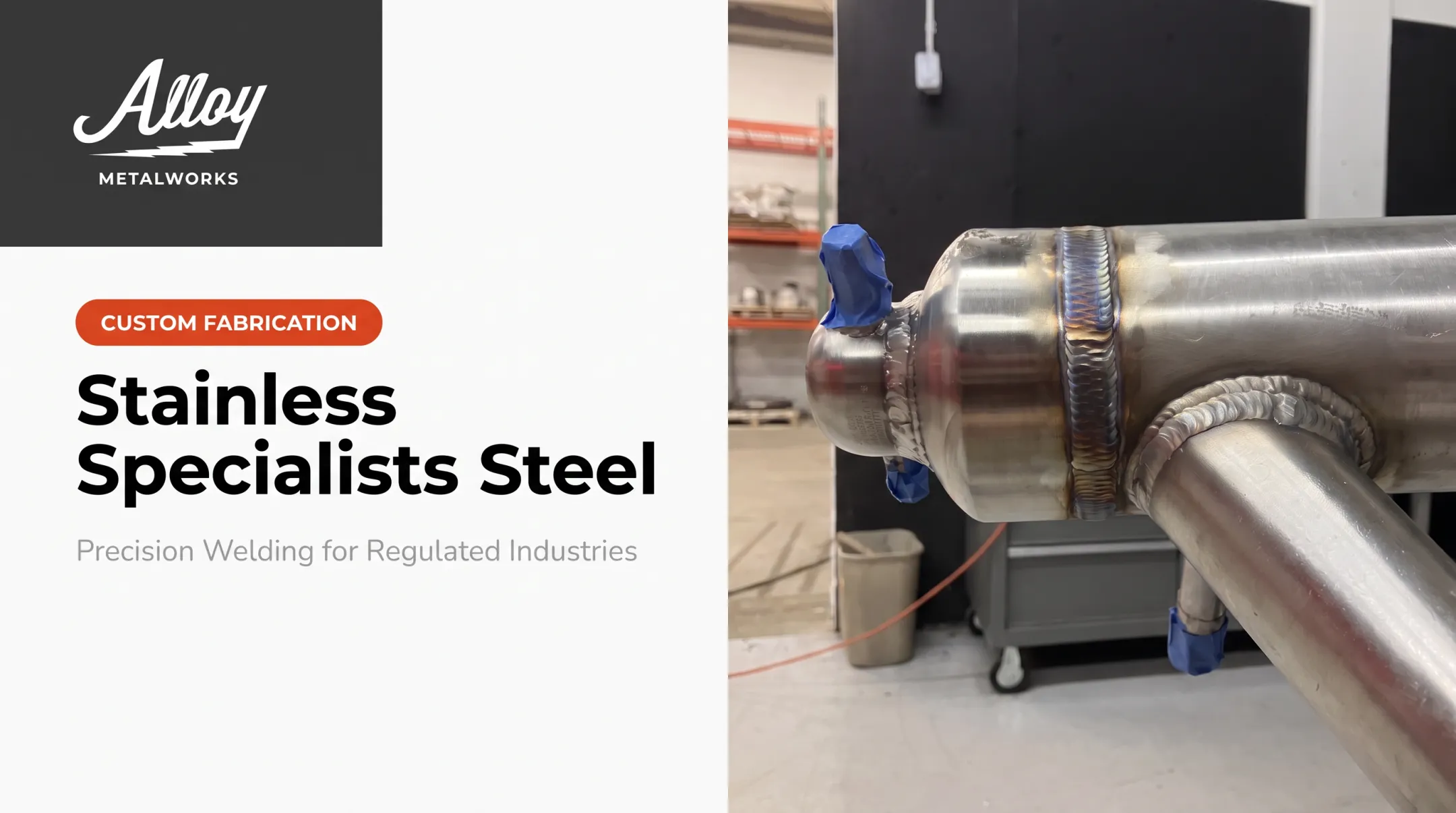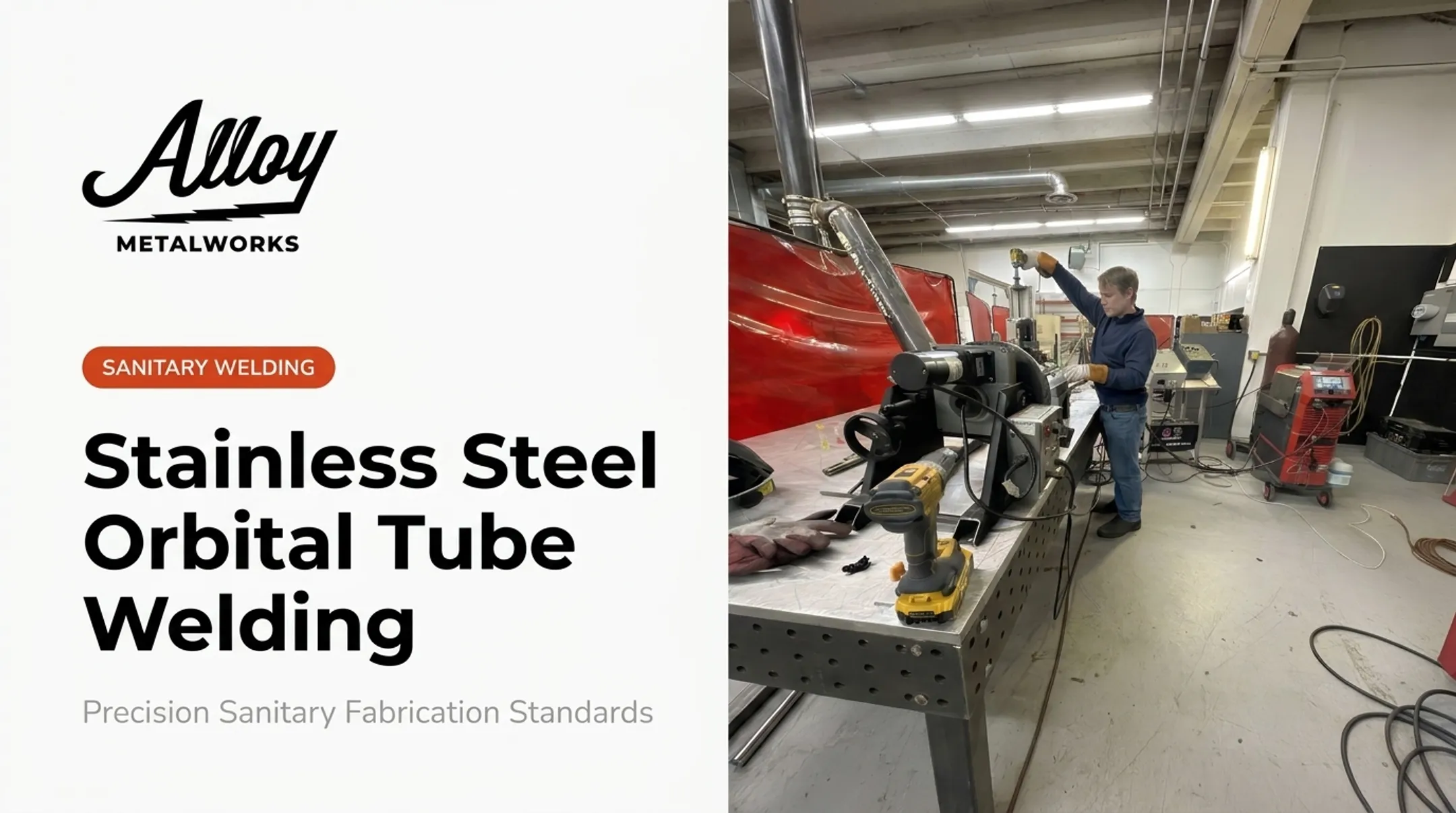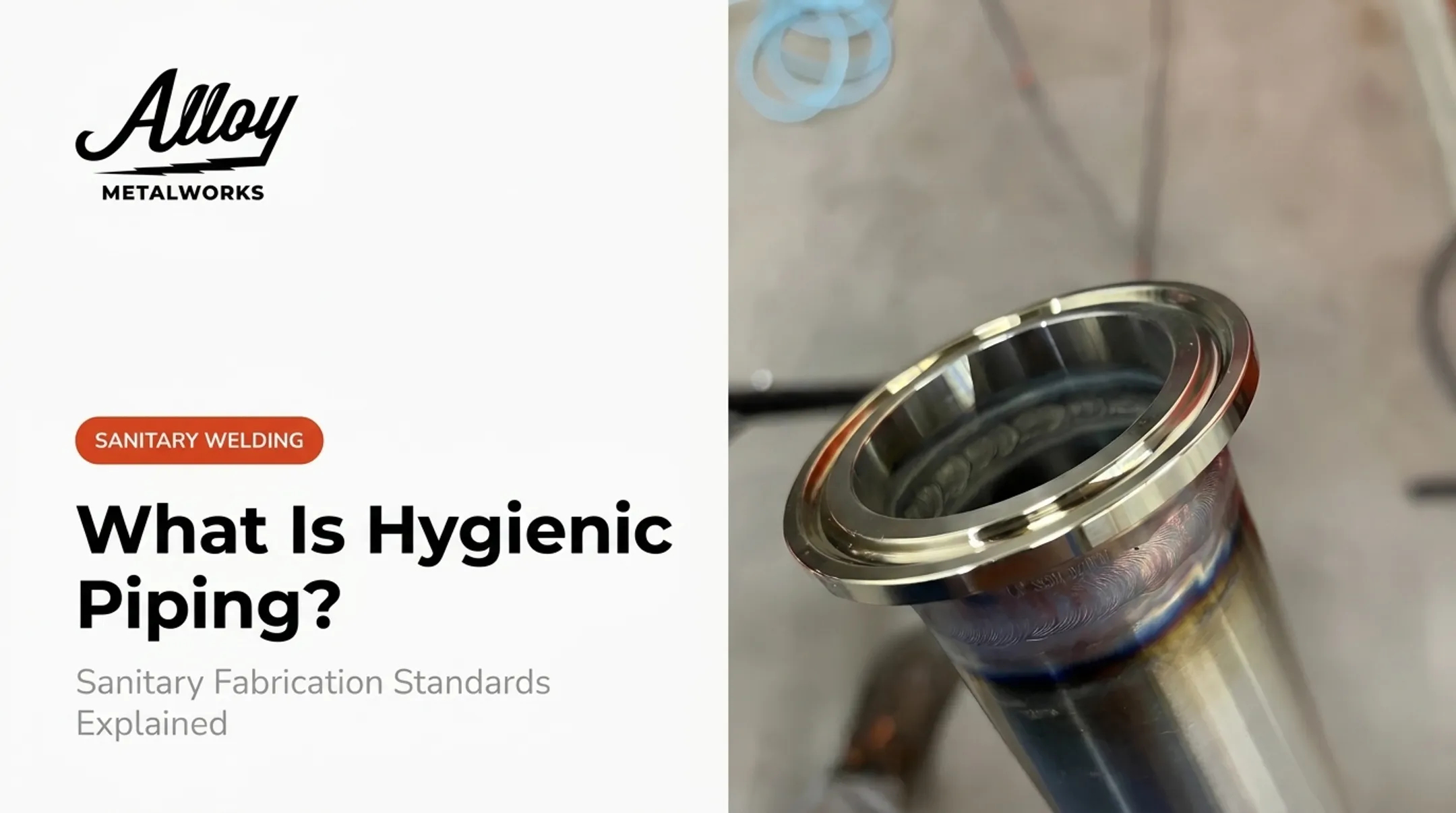

Sanitary welding isn't just stainless steel welding done carefully — it's a distinct discipline with its own codes, inspection protocols, and pass/fail criteria. Food and beverage plants, pharmaceutical manufacturers, biotech labs, and clean energy processing systems all depend on it, because their product lines can't tolerate crevices, discoloration, or trapped bacteria hiding in a seam.
This guide walks through the standards governing sanitary welds, how the process actually works, the defects that disqualify a weld, and what to look for when choosing a fabrication partner.
Key Takeaways
- Sanitary welds must meet AWS D18.1 and USDA 3-A standards to prevent contamination and product loss.
- GTAW (TIG) welding, often orbital, is the industry-preferred process for its precision and heat control.
- Purging, surface finish, and inspection decide hygienic acceptance as much as the weld bead itself.
- A certified, code-compliant fabricator reduces downstream compliance risk.
What Is Sanitary Stainless Steel Welding?
Sanitary (or hygienic) welding is a specialized technique for joining stainless steel components in industries where product purity can't be compromised. Think dairy tanks, pharmaceutical piping, and biotech bioreactors — anywhere a weld touches a product that eventually reaches a person.
Most sanitary work uses austenitic stainless grades, typically 304 or 316L, chosen for corrosion resistance, strength, and their ability to hold a smooth, cleanable finish. Alloy Metalworks works with these grades regularly, alongside 347, 17-4, 15-5, and duplex stainless for related industrial applications.
A sanitary weld still has to be structurally sound. It also has to meet these product-contact goals:
- Full penetration with no lack of fusion
- No crevices, pits, or voids where bacteria could colonize
- Minimal to no discoloration on the product-contact surface
- A finish that's as smooth and cleanable as the surrounding tube

Structural welding asks, "Will this hold?" Sanitary welding asks that too, but also, "Can this be cleaned to zero contamination, every time?" That second question drives joint design, purge practice, finishing, and how the weld is inspected.
Sanitary Welding Standards and Codes You Need to Know
Sanitary welding lives under a specific set of codes, and knowing them matters when you're vetting a fabricator or reviewing a quote.
Key standards and codes:
- AWS D18.1: Primary U.S. spec for sanitary austenitic stainless tube and pipe; covers welder qualification, fabrication, visual examination, acceptance criteria, and documentation
- AWS D18.2: Photo-based guide to internal weld discoloration on austenitic stainless tube (a separate tool, not a chart inside D18.1)
- USDA 3-A Sanitary Standards: Design criteria for cleanability, drainability, radii, and inspection access, aligned with USDA and FDA expectations
- ASME BPE: Materials, fabrication, and certification requirements for pharma and biotech high-hygiene fluid systems
- FDA 21 CFR 117.40: Food-contact equipment must be cleanable, corrosion-resistant, and free of seams that trap contaminants
The full AWS D18.1 title is the "Specification for Welding of Austenitic Stainless Steel Tube and Pipe Systems in Sanitary (Hygienic) Applications." Knowing D18.2 on its own helps you speak the same language as your fabricator when reviewing discoloration acceptance.
3-A standards date to the 1920s, when regulatory sanitarians, equipment fabricators, and dairy processors formed the coalition behind the name.
When you vet credentials against these codes, Alloy Metalworks' welders—including Technical Director Chris Gavitt and Fabrication Lead Randy Zavala—hold AWS D18.1 certification, and the company fabricates sanitary systems to USDA 3-A standards.
The Welding Process: How Sanitary Welds Are Made
GTAW (TIG) welding is the standard for sanitary applications. It produces a clean arc, minimal spatter, and precise heat control: exactly what you need when the inside of a weld has to stay smooth and free of contamination.
Manual vs. Orbital TIG
Two approaches cover most sanitary tube work:
- Manual TIG handles complex geometries, tight access points, and one-off repairs
- Orbital TIG rotates the electrode around a stationary tube under tightly controlled parameters

For high-volume, repeatable production runs, orbital welding delivers consistency that is hard to match manually.
Back Purging and Heat Tint Control
Before, during, and after welding, the interior of the pipe gets flooded with inert gas, usually argon, to prevent oxidation on the ID surface. Without adequate purge gas purity and flow, you get discoloration (heat tint), and heat tint is directly linked to reduced corrosion resistance.
Acceptable discoloration runs on a scale from bright, chrome-like color down through light gold. Anything darker signals oxidation that can compromise the surface long-term. AWS D18.2's visual guide gives fabricators and inspectors a shared reference point for that scale.

Where Laser and Electron Beam Fit
For ultra-thin or heat-sensitive components, laser and electron beam welding come into play. Laser welding's lower heat input shrinks the heat-affected zone, which matters on delicate parts. These remain project-specific specialty options, not a default replacement for GTAW in standard sanitary tube work.
What Makes a Weld Actually "Sanitary"
A technically sound weld can still fail sanitary requirements if it doesn't support cleaning protocols like CIP (clean-in-place) and SIP (sterilize-in-place). The weld has to be as smooth and cleanable as the tube it's joining. No exceptions.
Defects that disqualify a sanitary weld include:
- Cracks or lack of fusion
- Porosity or slag inclusions
- Misalignment between joined sections
- Concavity or convexity beyond acceptable limits
- Undercutting at the weld toe
- Excessive discoloration on the ID surface
Surface Finish: Mechanical Polishing vs. Electropolishing
Surface finish is measured in Ra (roughness average). 3-A guidance calls for a finish equivalent to or smoother than 32 microinches. Mechanical polishing gets you there in many cases.
Electropolishing goes further and is especially valuable in ultra-high-purity systems where minimizing bacterial adhesion is critical. One caveat: electropolishing can't fix a bad weld. It won't repair lack of fusion or poor geometry; it only refines a sound weld's surface.
Dead Legs: The Silent Contamination Risk
A "dead leg" is a poorly designed or welded section — often a branch or fitting — that can't be reached by normal cleaning or sterilization. Product sits there, stagnates, and becomes a breeding ground for biofilm. Avoiding dead legs requires attention at the design stage, not just at the weld itself.
Inspection, Documentation, and Quality Assurance
Visual inspection catches obvious surface flaws, but it can't see what's happening inside the joint. That's why sanitary welding programs lean on additional inspection methods:
- Borescope inspection — a camera threaded through the tube ID to check for discoloration, porosity, or incomplete fusion inside the weld
- Dye penetrant testing — reveals cracks and porosity invisible to the naked eye
- Radiographic testing — used selectively, based on project specification and code requirements, to check for subsurface defects

None of these replace a documented Welding Procedure Specification (WPS). A WPS records the exact parameters — amperage, travel speed, purge gas flow, filler material — used to produce a qualified weld. Without it, there's no traceability if something goes wrong downstream.
Post-weld passivation is a chemical treatment (governed by ASTM A967) that restores the chromium oxide layer on stainless steel, protecting the corrosion resistance that welding heat can disturb. A properly passivated part shows no etching, pitting, or frosting under inspection.
Alloy Metalworks operates under ISO 9001-controlled processes and documents sanitary work to AWS D18.1 standards. Every weld comes with documentation and traceability — a meaningful advantage for regulated clients who need audit-ready records, not just a finished part.
Choosing the Right Partner for Sanitary Welding Projects
Certifications matter, but they're a starting point, not a guarantee. A welder certification only proves competence on a narrow set of variables at a single point in time. It doesn't automatically mean every weld a shop produces will meet spec. When vetting a sanitary welding partner, look for:
- Current certifications: AWS D18.1 for sanitary tube/pipe, ASME Section IX for procedure qualification
- An active quality system: ISO 9001 shows process control, not proof every weld meets D18.1 or 3-A
- Alloy experience: familiarity with 304/316L, plus dissimilar metals if your system requires them
- Engineering collaboration: a partner involved from design through built parts, not just execution Alloy Metalworks holds ASME Section IX, AWS D18.1, and ISO 9001 credentials, and works across food and beverage, pharmaceutical, water treatment, and energy sectors. Recent projects include a brewhouse upgrade for Holidaily Brewery, completed on time and within budget, and an Alloy 800HT thermochemical reactor component for the National Renewable Energy Laboratory operating above 700°C. Different industries, same emphasis on weld procedure development, contamination control, and documentation.
Frequently Asked Questions
What is sanitary welding?
Sanitary welding is a hygienic joining technique for stainless steel used in food, pharmaceutical, and biotech applications. It prioritizes defect-free, cleanable results over pure structural strength.
What are the 3-A sanitary welding standards?
3-A standards define hygienic equipment design and cleanability requirements for dairy, food, and related process systems. They align with USDA and FDA expectations and work alongside AWS D18.1 for welding-specific criteria.
What is sanitary stainless steel?
Sanitary-grade stainless steel typically refers to austenitic grades like 304 or 316L. Their corrosion resistance and ability to hold a smooth, cleanable finish make them ideal for hygienic environments.
Can I TIG weld stainless to mild steel?
Stainless-to-mild-steel joints are possible with the right filler, but they raise corrosion and cleanability risks. For true sanitary work, avoid this mix unless a project-specific qualified procedure supports it.
What welding process is best for sanitary applications?
GTAW (TIG) welding, manual or orbital, is the industry standard. It offers the precision, clean arc, and contamination control that sanitary applications demand.
How is a sanitary weld inspected for quality?
Visual inspection catches surface issues such as discoloration, undercut, and incomplete penetration. Internal defects require borescope, dye penetrant, or radiographic testing based on the inspection plan and governing code.