
Structural welders build for load-bearing capacity. A reinforced bead is often a good thing. In dairy fabrication, that same reinforced bead — sitting proud inside a pipe — becomes a bacterial harborage point. The FDA's 2024 investigation into a multistate Listeria outbreak tied to queso fresco and cotija cheese resulted in 26 illnesses, 23 hospitalizations, and two deaths, with environmental sampling matching the outbreak strain in the processing environment. That case didn't pin blame on a specific weld, but it illustrates exactly why sanitary design principles exist: harborage sites in equipment are where pathogens survive routine sanitation.
This article covers the standards, processes, materials, inspection methods, and partner qualifications that separate compliant dairy welding from a liability waiting to happen.
Key Takeaways
- Dairy pipe welds must meet AWS D18.1 and align with 3-A Sanitary Standards to minimize bacterial harborage
- 316L stainless steel is the go-to grade for dairy due to its resistance to CIP cleaning chemicals and chlorides
- Orbital TIG welding delivers repeatable, crevice-free welds that manual welding struggles to match consistently
- Post-weld passivation and documented inspection are required steps in a compliant dairy welding process
What Makes Dairy Pipe and Tube Welding Different
Dairy welds must sit flush with the inner pipe wall. That standard differs sharply from structural welding, where a raised bead simply adds strength.
Sanitary dairy work leaves no room for:
- Crowns or raised beads on the product-contact surface
- Undercuts that create crevices
- Dead legs where product can pool
Why this matters: rough surfaces, porosity, and crevices give bacteria like Listeria and Salmonella somewhere to hide from cleaning cycles. FDA guidance is direct on this point: equipment should be smooth, sealed, and free of dead ends where residues can accumulate and support microbial growth.
Heat tint is another tell. A weld turned dark blue or black, instead of a light straw color, signals a compromised chromium oxide layer. That layer is what gives stainless steel its corrosion resistance. AWS D18.2 is the visual guide for judging this discoloration against backing-gas oxygen levels.

Measuring Surface Smoothness
Surface roughness is now measured in Ra (micrometers), not old grit-based approximations. The 3-A primer sets a general benchmark of 32 microinches (0.8 µm) Ra or smoother, free of pits, folds, and crevices. Meeting 3-A criteria alone still does not guarantee CIP compatibility for every chemical regime.
Standards and Codes Governing Dairy Welding
Several overlapping frameworks govern dairy pipe welding, and knowing which applies where matters for compliance.
| Standard | What It Covers |
|---|---|
| AWS D18.1 | Specification for welding austenitic stainless tube/pipe in sanitary applications: qualification, fabrication, and acceptance criteria |
| 3-A Sanitary Standards | Food-contact equipment design and fabrication criteria; often referenced in USDA/FDA sanitary design expectations |
| ASME BPE | Dimensional and surface finish requirements, more common in pharma/bioprocessing but a useful reference point |
| EHEDG | International hygienic engineering guidelines, useful for global-facing projects |
Documentation ties these frameworks together. ISO 9001-controlled traceability is what lets a fabricator prove compliance in a plant audit: material certs, procedure records, and inspection logs, not just a certificate on the wall.
Alloy Metalworks holds AWS D18.1 sanitary welding certification alongside ISO 9001 QMS—the paper trail auditors expect when they walk a dairy facility.
Welding Processes Used for Dairy Pipe and Tube
Orbital TIG Welding
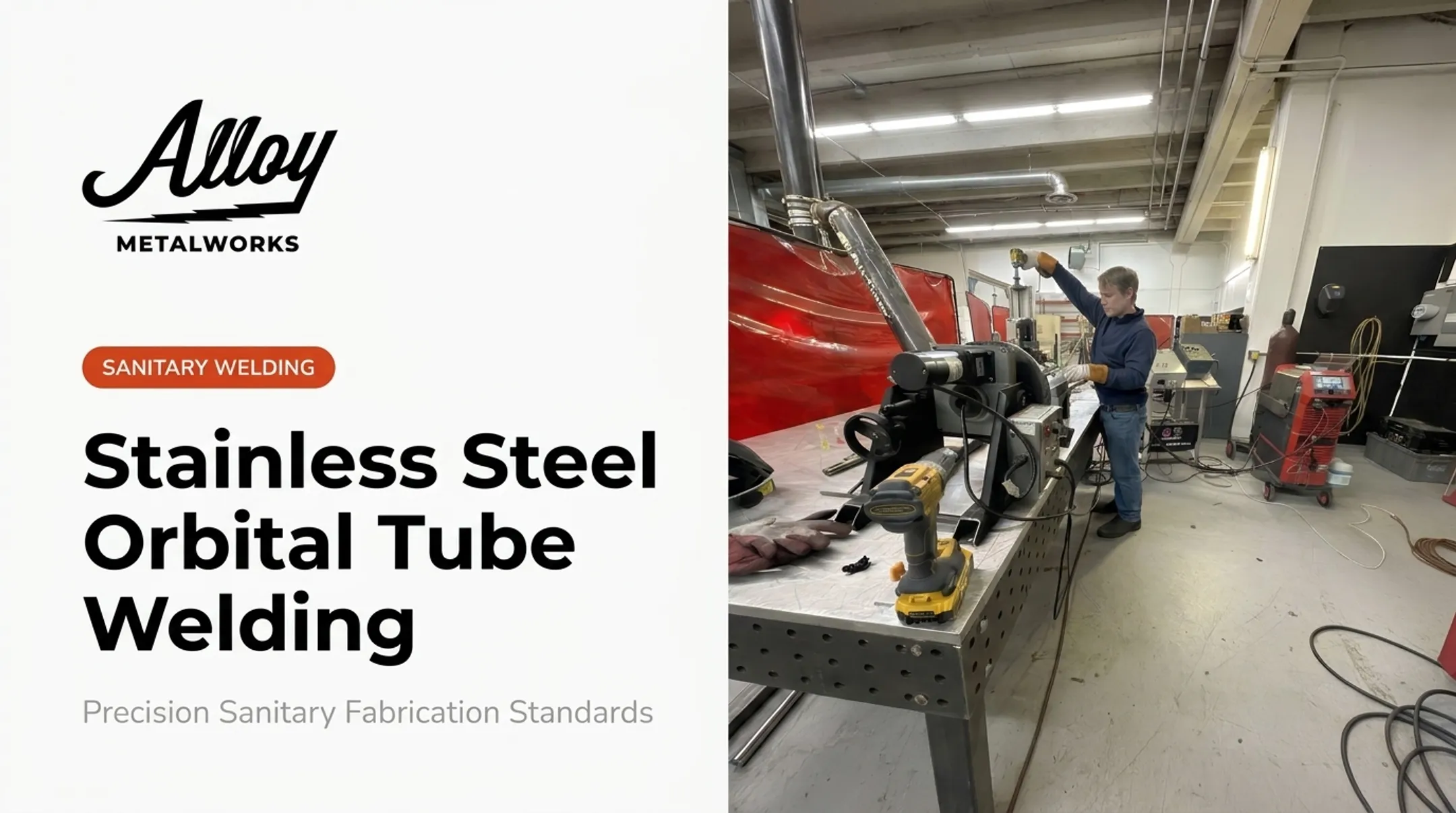
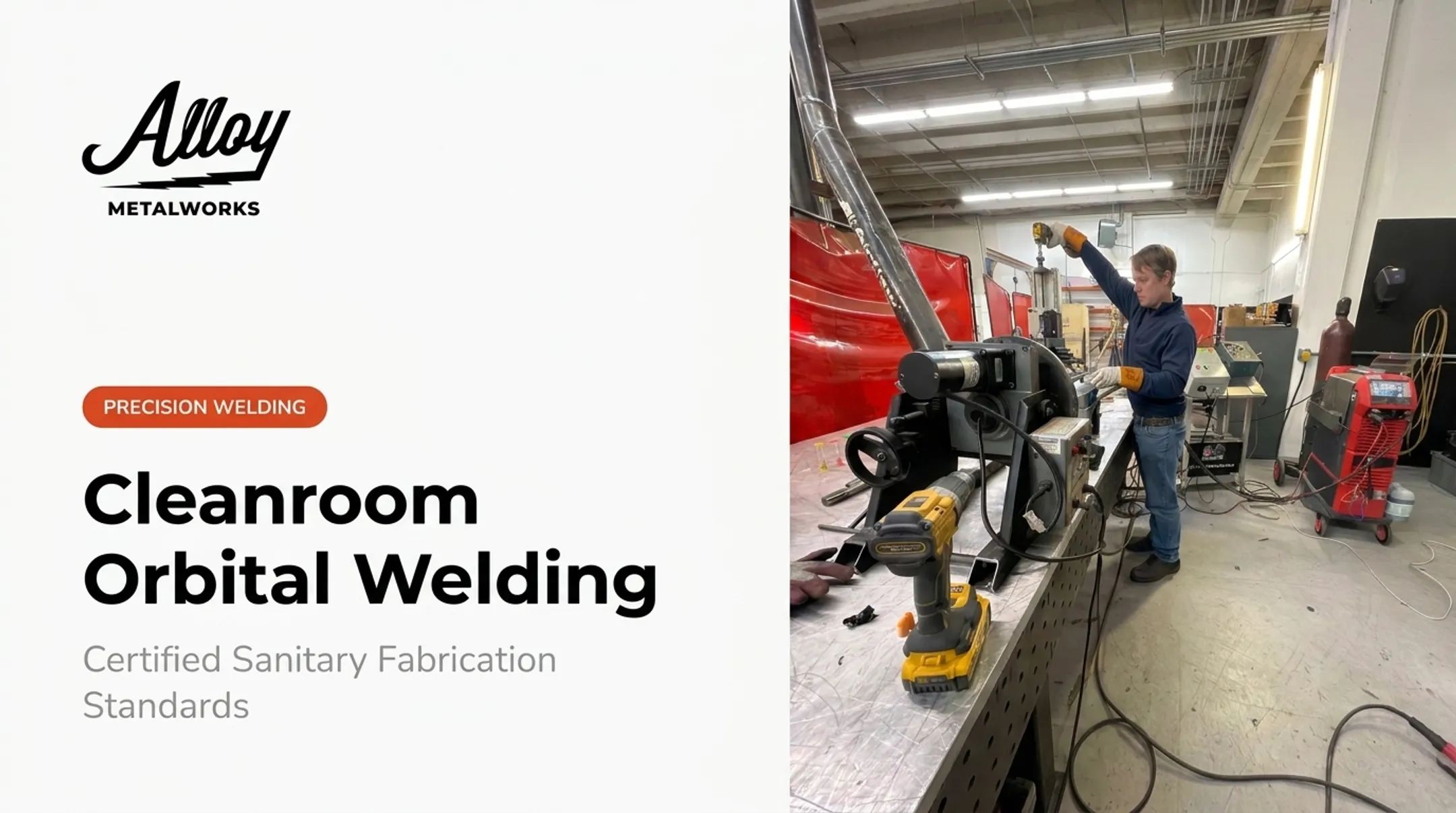
Orbital GTAW is the industry's preferred method for a simple reason: it removes operator-to-operator variation. Programmable parameters mean the same weld quality, cycle after cycle — critical when you're producing dozens of identical joints across a processing line.
Back purging is the detail that makes or breaks these welds. Swagelok's research on orbital welding notes that purge procedure is often what determines success or failure, since inadequate inert gas flow inside the tube lets oxygen reach the weld and oxidize the interior. Ten volume changes during prepurge is a common benchmark.

Manual TIG Welding
Manual TIG still has a role: repairs, irregular joints, nozzles, and manways that don't fit a standardized orbital head. It requires a skilled welder working under an equally controlled, qualified procedure. Skill alone doesn't substitute for documentation.
Other Methods: PAW and Seam Welding
Plasma arc welding and automated seam welding come into play for larger tanks and vessel seams — think circumferential welds on a bulk storage tank rather than small-diameter process pipework. Orbital welding stays the standard for pipe runs; rotary/seam methods take over for vessel fabrication.
Material Selection for Dairy Applications
304 stainless steel works for general food-contact surfaces. 316L is the specification for dairy because of its added molybdenum content, which improves resistance to chlorides and the aggressive chemicals used in Clean-in-Place (CIP) cycles.
The "L" designation matters too. Low-carbon grades reduce carbide precipitation in the weld and heat-affected zone. Left unchecked, that precipitation raises the risk of intergranular corrosion in the joint.
Key material specs for high-purity dairy applications:
- Grade: 316L stainless steel
- Surface finish: Ra ≤ 0.4 µm for high-purity lines
- Carbon content: ≤ 0.03% C ("L" grade) to limit carbide precipitation
- Documentation: Heat number and mill cert tracked on the weld procedure record
One caution from the Nickel Institute: 316L generally outperforms 304L in corrosion resistance, but 304L can actually hold up better in strongly oxidizing acids like nitric acid. Grade selection should follow the specific CIP chemistry, not a blanket assumption.

Post-Weld Treatment, Inspection, and Common Mistakes
Passivation Restores the Protective Layer
Welding heat disrupts the chromium oxide layer that protects stainless steel from corrosion. Passivation using nitric or citric acid gel restores that layer after welding and cleaning. ASTM A967 governs chemical passivation treatments, including immersion methods and lot-testing procedures like the copper sulfate test.
Common Mistakes to Avoid
- Welding dissimilar metals without addressing galvanic compatibility
- Leaving burrs or sharp edges inside pipe runs
- Overstressing surfaces with excessive heat input
- Using bolted connections instead of sealed welds where a hygienic joint is required
- Welding into inner corners that trap residue and resist cleaning
Inspection That Actually Catches Problems
Visual inspection checks bead color and uniformity as the first line of defense. Where the tube ID isn't accessible, a borescope lets inspectors check the weld interior for debris, cracks, and integrity issues on sanitary tubing projects.
Periodic destructive cross-section testing rounds out critical joints, verifying penetration and structure that visual methods alone can't confirm.
Poorly controlled heat input or inadequate shielding gas damages the passive layer through alloy depletion. Post-weld nondestructive examination confirms both corrosion resistance and that the weld met penetration and integrity requirements.

Choosing a Qualified Dairy Welding Partner
Documentation separates a compliant fabricator from one that just "does welding." A qualified partner should hand over:
- Weld procedure qualification records proving the process was tested and approved
- Material certificates with heat numbers tracing every component back to its source
- Inspection reports covering visual, borescope, and any destructive testing performed
During an on-site pipe-spool rebuild, a previous contractor couldn't produce documentation for the original welds or welder qualifications at all.
The replacement work followed ASME B31.3 standards with visual inspection, in-house borescope and dye-penetrant testing, and third-party magnetic particle testing. That layered verification is what a dairy audit expects to see.
Engineering-aware collaboration matters as much as welding skill. Alloy Metalworks brings AWS D18.1 sanitary welding certification and ISO 9001 quality processes to food and beverage projects, including a brewhouse upgrade for Holidaily Brewery.
Facility Manager Jacob Hertz credited the team's preparation and attention to detail for finishing that project on time and within budget. Dairy processors should require that same documentation discipline from any partner handling sanitary piping.
Frequently Asked Questions
What is an HDPE welder?
An HDPE welder fuses high-density polyethylene pipe with heat fusion, not electric arc welding. That process differs from TIG or orbital welding on stainless dairy systems, though HDPE sometimes appears in non-product-contact lines such as wastewater.
What stainless steel grade is best for dairy pipe welding?
316L is the industry standard for dairy applications because of its superior resistance to CIP cleaning chemicals and chloride exposure. The low-carbon "L" designation also reduces carbide precipitation at the weld zone.
Why is orbital welding preferred over manual TIG for dairy pipe systems?
Orbital welding delivers consistent, repeatable welds without operator-to-operator variation, which matters across dozens of identical joints. It also produces documented, qualified process records that compliance audits require.
What certifications should a dairy welding contractor hold?
Look for AWS D18.1 sanitary welding certification, ISO 9001 quality management, and fabrication practices aligned with USDA 3-A Sanitary Standards. These together demonstrate both technical capability and documented traceability.
How is a sanitary weld inspected after completion?
Inspection typically starts with visual checks of bead color and uniformity, followed by borescope examination of the internal bore where accessible. Critical joints may also undergo periodic destructive cross-section testing to confirm penetration and structure.
What happens if a dairy pipe weld isn't passivated?
Without passivation, the weld area lacks a fully restored chromium oxide layer, leaving it more vulnerable to corrosion and bacterial adhesion. That weakens the hygienic design the rest of the system was built to achieve.