
Welders, cutters, solderers, and brazers held 457,300 jobs in the U.S. in 2024, according to the Bureau of Labor Statistics. That's a large but narrow slice of a much bigger manufacturing ecosystem called fabrication.
This guide breaks down the real difference between the two, walks through the fabrication process step by step, explains what drives cost, and shows you how to vet a partner who can deliver inspection-ready work the first time.
Key Takeaways
- Fabrication is the full build process; welding is one joining step inside it
- Fabrication can skip welding (fasteners, rivets); most welding still sits inside a broader fabrication scope
- Certifications like ASME Section IX, AWS D17.1, and ISO 9001 signal documented, inspection-ready work
- Cost varies with material, geometry, certification needs, and volume
- One shop from design through finishing cuts handoff risk and delays
What Is Fabrication in Welding?
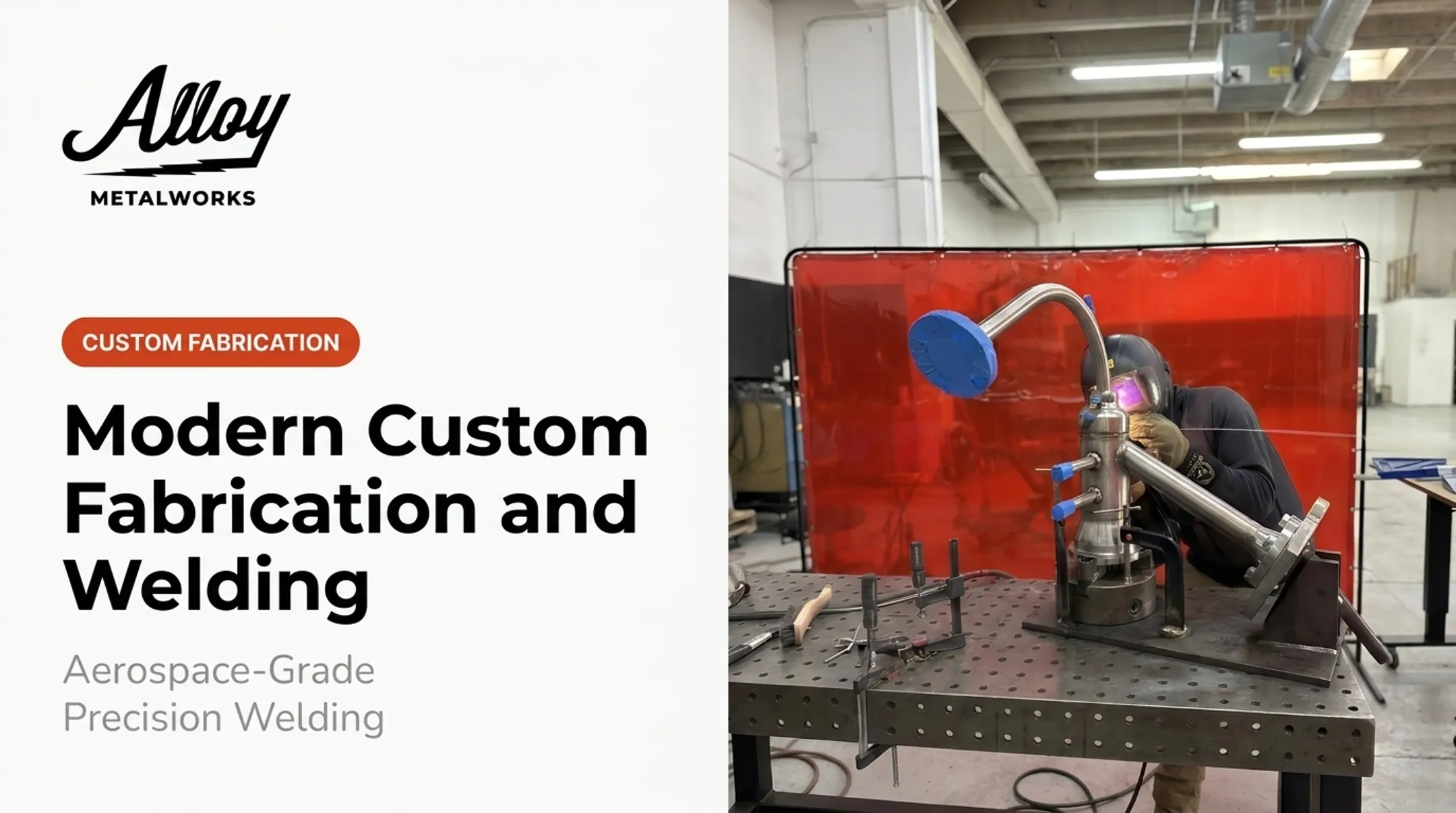
Metal fabrication is the entire journey from raw material to finished part: design review, cutting, forming, welding, finishing, and installation. Welding sits inside that chain as the step where heat or pressure permanently joins two pieces of metal.
The trade publication The Fabricator describes a shop's full scope as spanning stamping, bending, cutting, grinding, and polishing, not just joining. That's the distinction buyers miss most often.
Three Fabrication Categories
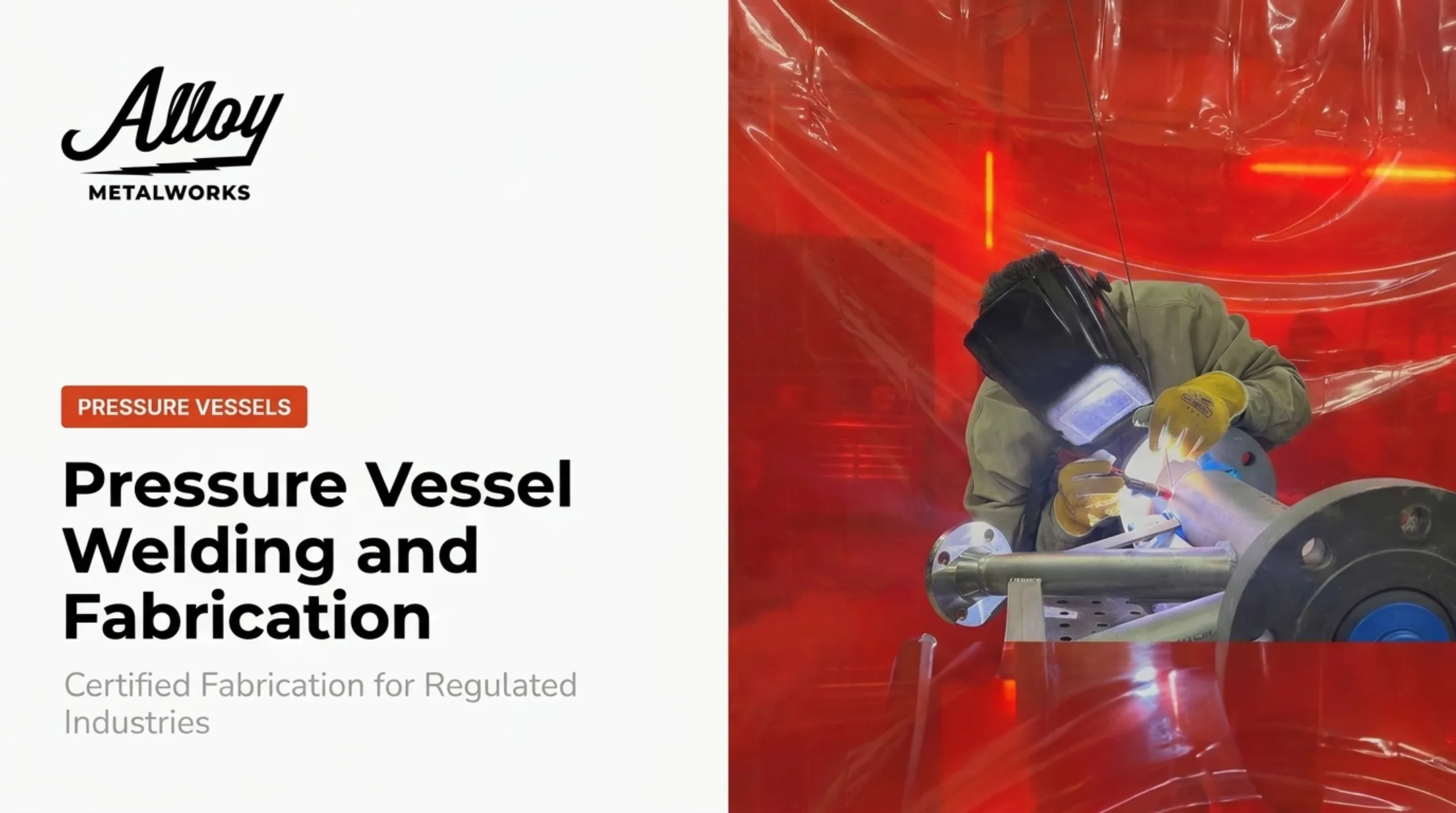
- Industrial fabrication — process piping, pressure vessels, vacuum chambers, reactor systems
- Structural fabrication — support frames, ground support equipment, load-bearing assemblies
- Commercial fabrication — custom fixtures, tooling, and small-batch components
Alloy Metalworks touches all three: aerospace ground support equipment, energy system components, and sanitary stainless piping for food and pharma clients.
The U.S. fabricated structural metal manufacturing market hit $65.5 billion in 2025, growing at a 9.7% CAGR since 2020, according to IBISWorld. That figure covers structural metal specifically, not the entire welding trade, but it shows the scale of demand behind these builds.
Beyond Welding
Fabrication techniques also include:
- Cutting (laser, plasma, waterjet)
- Machining
- Casting
- Stamping and punching
- Forming and bending
Many fabricators are cross-trained welders, and vice versa. For regulated work, though, specialization matters. A general fabricator isn't automatically qualified to weld flight-critical hardware.
Welding vs. Fabrication: Key Differences
Here's the hierarchy: welding is always part of fabrication, but fabrication doesn't always require welding. A bolted steel frame is fabrication without a single weld bead.
Different Skill Sets
- Welders focus on heat control, joint integrity, and executing a qualified procedure
- Fabricators manage design interpretation, build sequencing, and full-assembly quality
- Fabricator-welders own fit-up through final inspection on the same part
Different Tools
| Welding | Fabrication |
|---|---|
| Arc welders, filler electrodes | Shears, press brakes |
| Shielding gas setups | CNC machines, laser cutters |
| Torches, tungsten electrodes | Forming rolls, punches |
The Numbers Tell the Story
| Occupation | Employment | Median pay |
|---|---|---|
| Welders, cutters, solderers, brazers | 457,300 (2024) | $51,000 |
| Assemblers and fabricators | 1,799,500 (2025) | $45,450 |
Source: BLS Welders data and BLS Assemblers and Fabricators data. These pools overlap but aren't interchangeable. A large assembler workforce doesn't prove a shop has code-qualified welders on staff.
What a Fabricator Welder Actually Does
A day on the floor looks like this: read blueprints, prep and fit joints, run the weld per procedure, then check dimensions and surface finish before the part moves to the next station. Striking an arc is only one step; the real work is managing the whole build sequence.
For flight-critical or nickel-alloy work, general fabrication skill isn't enough. Codes like AWS D17.1 require welders to qualify against specific procedures, materials, and positions before touching production hardware.
The Fabrication Process, Step by Step
A controlled build follows a predictable sequence:
- Design and material review — drawing revision, material grade, tolerances confirmed
- Cutting — parts cut to size and nest for yield
- Forming and bending — geometry established before permanent joins
- Welding and assembly — joints executed per WPS
- Finishing — surface treatment, deburring, cleanup
- Inspection — visual and NDE checks against acceptance criteria

Sequence matters more than most project teams expect. Weld heat expands and contracts metal. Restraint during that cycle leaves residual stress that can distort the whole assembly, according to Lincoln Electric's guidance on weld distortion. Weld before bending, and you risk costly rework.
For flight-critical or first-run parts, prototypes and process validation typically come before full production. Alloy Metalworks builds this into Inconel and titanium jobs. A successful prototype weld still has to be proven repeatable before it scales.
Types of Production Welding and Materials
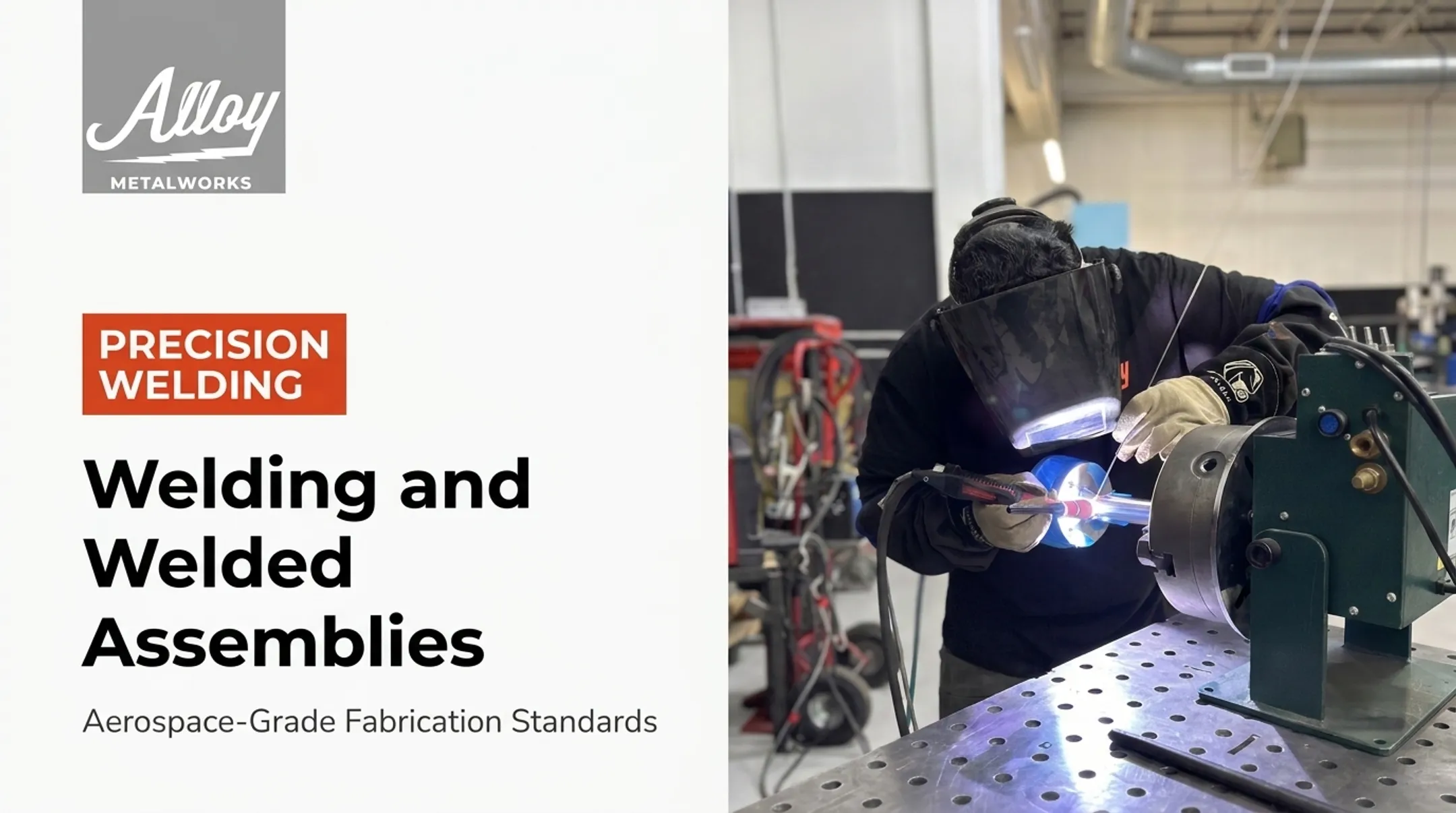
Production welding means repeatable, procedure-driven welding for volume manufacturing — distinct from a one-off custom repair job. It runs on a fixed WPS, consistent fixturing, and often automation.
The Four Common Processes
- MIG/GMAW — fast, continuous wire feed; good for general fabrication and thicker material
- TIG/GTAW — precise tungsten-arc control; best where cleanliness and root quality matter, per Miller's TIG welding overview
- Stick/SMAW — portable, field-friendly, works on mild steel, stainless, cast iron
- FCAW — flux-cored wire for heavy-duty, high-deposition work
Process choice alone is not enough when the base metal is a high-performance alloy. Atmosphere control becomes part of the procedure.
Specialty Alloys and Atmosphere Control
- Titanium — argon back-purging to prevent oxidation
- Inconel and Hastelloy — controlled purge flow to hold oxygen and nitrogen below strict thresholds
- Dissimilar-metal joints — qualified procedures so each alloy stays within its heat and dilution limits
Alloy Metalworks uses custom inert gas chambers built for titanium welding, keeping an oxygen-free environment that protects strength and corrosion resistance. The shop also runs cold-wire TIG and pulse-spray MIG when production programs need the same result part after part.

How Much Does Welding Fabrication Cost?
There's no universal per-inch or hourly rate that applies across aerospace, energy, and sanitary work. Four factors drive the number:
- Material type — carbon steel runs far cheaper than Inconel, Hastelloy, or titanium
- Part complexity and geometry — access difficulty and joint count matter more than people expect
- Certifications and documentation — WPS, WQR, and traceability records add cost but reduce downstream risk
- Production volume — one-off prototypes cost more per unit than repeat production runs
Design choices can outweigh the hourly rate. In one structural example, adding 6-inch doubler plates to a beam design increased overall weld volume by 72 times, according to The Fabricator's analysis of hidden cost drivers.

A low quoted rate means little if the design creates that much extra weld metal.
Ask for itemized quotes that separate design, fabrication, welding, and finishing. That's the only way to compare vendors fairly instead of chasing the lowest number on a single line item.
Choosing a Certified Fabrication and Welding Partner
Not every certification means the same thing. Match the credential to the actual part:
- AWS D1.1/D1.2/D1.6 — structural steel, aluminum, and stainless steel welding codes
- AWS D17.1 — flight-critical aerospace hardware
- AWS D18.1 — sanitary and hygienic stainless systems
- ASME Section IX — welding procedure and personnel qualification
- ISO 9001 — quality management system (not a welding code itself)
A shop that handles design collaboration, welding, and documentation in-house cuts out the handoffs between subcontractors, and the delays that come with them.
Alloy Metalworks, a Colorado-based shop founded in 2020, holds ASME Section IX, AWS D17.1 Class A, AWS D18.1, AWS structural codes, ISO 9001, and FAA Part 145 QMS credentials. The team serves aerospace, energy, and research clients including NREL and Utility Global.

Before committing, request Weld Procedure Specifications (WPS) and Welder Qualification Records (WQR). If a shop hesitates to produce them, that's your answer.
Frequently Asked Questions
How much does welding fabrication cost?
Costs depend on material type, part complexity, certification requirements, and production volume. Request an itemized quote separating design, fabrication, welding, and finishing to compare vendors accurately.
What is fabrication in welding?
Fabrication is the complete build process: design, cutting, forming, welding, finishing, and installation. Welding is one joining step within that larger workflow.
What does a fabricator welder do?
A fabricator welder reads blueprints, preps and fits joints, executes multi-step assembly per a qualified procedure, and performs quality checks throughout the build.
What's the difference between welding and fabrication?
Fabrication often includes welding, but it doesn't always require it; mechanical fastening is one alternative. Fabrication is the broader process; welding is a subset of it.
What is production welding?
Production welding is repeatable, procedure-driven welding used for volume manufacturing, as opposed to custom one-off jobs. It relies on a fixed WPS and consistent fixturing for repeatable quality.