
Get it wrong, and the consequences aren't theoretical. Poor design creates contamination risk, failed audits, and — in the worst cases — full product recalls.
This article breaks down what makes piping truly hygienic, the design rules that matter, the materials and fittings involved, and how these systems get cleaned and verified.
Key Takeaways
- Hygienic piping must be cleanable without disassembly via Clean-in-Place (CIP) systems
- Four design rules govern cleanability: no dead legs, proper drain slope, smooth surfaces, adequate CIP velocity
- Stainless steel (304/316L) remains the default for corrosion resistance and cleanability
- Weld quality, not just material or geometry, is often where hygienic systems fail
What Is Hygienic Piping?
Hygienic piping transports food, beverage, pharmaceutical, or biotech products while remaining fully cleanable, typically through CIP (Clean-in-Place) rather than manual disassembly. The core requirement is simple to state and hard to achieve: every internal surface must be reachable by cleaning fluid at the right velocity and temperature, and the system must drain completely afterward. Any surface the cleaning fluid can't reach, or any liquid that pools instead of draining, becomes a place for bacteria to grow. Common applications include:
- Dairy and juice transfer lines
- Pharmaceutical water systems
- Ingredient mixing systems
- Brewery and biotech process lines
Hygienic vs. Sanitary vs. Industrial Piping
"Hygienic" and "sanitary" get used interchangeably in most conversations, and for everyday use that overlap is fine. But hygienic design specifically emphasizes CIP-compatibility and geometry — not just picking a corrosion-resistant material and calling it done. Standard industrial piping (carbon steel, PVC) is built for durability and pressure handling. It was never designed with cleanability in mind, and using it in a product-contact application is asking for trouble. The stakes are concrete. In the Blue Bell Creameries Listeria outbreak, FDA investigators found equipment design that made thorough cleaning difficult. The company decommissioned the machine and recalled all product from the affected facility FDA's 2016 root-cause response. The Department of Justice later reported a $17.25 million criminal penalty, tied in part to inadequate cleaning conditions (DOJ, 2020). One case shows how cleanability failures become real safety and business consequences. What follows breaks down the design rules, materials, and fabrication practices that keep hygienic piping inspectable and CIP-ready.
The Core Design Rules That Make a System Truly Cleanable
Four rules govern whether a piping system can actually be validated as hygienic. Skip one, and the whole system fails cleaning validation regardless of how good the others are.
1. No dead legs. Branch length shouldn't exceed roughly 1.5–2x the pipe diameter. Longer branches create stagnant zones where cleaning fluid never reaches full velocity, and bacteria settle in.
2. Self-draining geometry. Horizontal runs need to slope toward drain points, typically at least 1%. Without slope, liquid pools after cleaning cycles and sits there until the next production run.
3. Smooth interior surfaces. Surface roughness should stay at Ra ≤ 0.8 µm. Rougher surfaces give microbes and residue something to grip onto, defeating even a well-designed CIP cycle.
4. Adequate flow velocity. CIP fluid typically needs to move at 1.5–2.1 m/s to generate enough turbulence to scrub interior walls — a benchmark from APV/SPX Flow CIP guidance, not a fixed universal number.
Welded joints and instrumentation ports need the same attention. A rough weld bead or a poorly oriented tee fitting can create a new dead leg, undoing everything else in the design.
These rules work as a system. A perfectly polished pipe with a bad slope still fails. A well-sloped run with a dead-leg branch still fails. Hygienic design isn't a checklist you can partially complete.

Materials Used in Hygienic Piping
Stainless steel — typically 304 or 316L — is the industry default. It resists corrosion, doesn't react with product, and can be polished and cleaned repeatedly without degrading.
Higher-purity applications need tighter material controls:
- 316L over 304 where chloride exposure, caustic concentration, or corrosion risk is elevated
- Specialty alloys with documented material traceability for biotech and pharma water systems
- Heat numbers, mill test reports, and passivation records where quality risk demands them
FDA aseptic-processing guidance confirms that rigid-wall stainless steel construction is widely used in these applications, though it doesn't mandate one specific grade for every use case. Material selection should follow the actual process chemistry and validation requirements, not a blanket rule.
Food-grade plastics such as PVC and polypropylene offer a lower-cost option in less demanding sanitary applications. The tradeoff is reduced temperature and chemical resistance compared to stainless.

Hygienic Fittings, Valves, and Tubing Explained
Hygienic tubing is different from standard pipe. It's pre-polished, seamless tubing with controlled dimensional tolerances, built specifically for orbital welding and CIP compatibility. Standard pipe wasn't designed with either of those in mind.
Hygienic fittings — tri-clamp ferrules, sanitary elbows, tees, reducers — exist to eliminate gaps and crevices where product could accumulate. Each connection point is a contamination risk unless the joint is drainable and crevice-free.
Valve selection matters just as much:
- Butterfly valves work well as compact hygienic shutoff devices for straightforward isolation
- Diaphragm valves keep a crevice-free flow path and suit sterile or high-purity service
- Mixproof valves separate two product paths in one body, preventing cross-contamination during simultaneous routing
No single valve type solves every problem. Choosing the right one depends on pressure, seat material, and CIP requirements for the line.

How Hygienic Piping Is Cleaned and Validated
A typical CIP cycle runs through several stages:
- Pre-rinse
- Caustic wash
- Intermediate rinse
- Acid wash
- Final rinse
The exact recipe—time, temperature, concentration, and flow—is validated for each system, not copied from a generic template.
Key standards that drive cleaning and validation requirements include:
- 3-A Sanitary Standards — cleanability and installation practices
- ASME BPE — design and construction specs for fluid-processing equipment
- FDA GMP — 21 CFR 117.40 (food) and 21 CFR 211.67 (drugs) require equipment cleaned and maintained at suitable intervals
Verification uses documented evidence, not assumptions. Common methods include:
- Riboflavin/UV testing — challenges spray coverage to confirm CIP fluid reaches every surface
- Borescope inspection — checks pipes and tanks for residue, corrosion, and weld defects
- Swab or rinse-water sampling — confirms residual soil or bioburden after the cycle

Why Welding Quality Is the Hidden Factor in Hygienic Piping
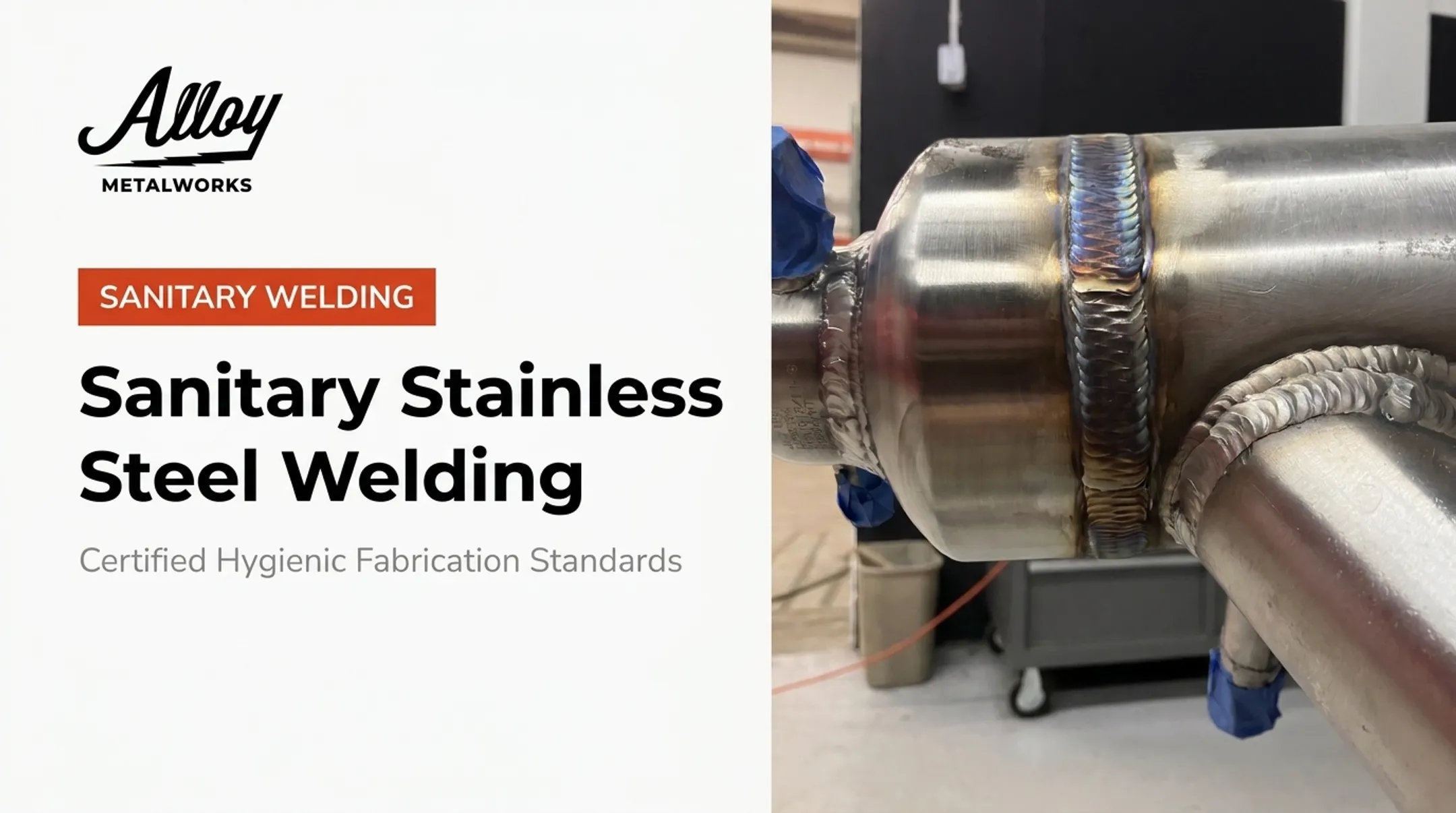
Here's what a lot of buyers miss: correctly specified stainless steel and perfect geometry can still fail if the welds are rough, porous, or improperly purged. Weld zones are the most common contamination hot spots in hygienic systems, because a bad weld creates exactly the kind of crevice the whole design was supposed to eliminate.
AWS D18.1 exists specifically to govern this. It's the specification for welding austenitic stainless steel tube and pipe systems in sanitary applications, covering weld finish, inert gas purging, and joint design for dairy and food-processing environments (AWS D18 Committee).
Alloy Metalworks fabricates sanitary stainless steel systems to AWS D18.1 sanitary welding standards, alongside ISO 9001-controlled quality processes and USDA 3-A standards. That combination, a documented weld procedure, qualified welders, and inspection-ready records, is what separates a system that passes an audit from one that fails a later facility inspection.
When sourcing a hygienic piping system, don't just ask about material grade. Ask fabricators:
- Are welders certified specifically to AWS D18.1?
- What purge method is used, and is it documented?
- Can you provide weld maps and inspection records?
- Is the QMS ISO 9001-controlled, with traceability from raw material to finished weld?
Material specs alone don't guarantee a cleanable, auditable system. The welding practice behind it does.
Frequently Asked Questions
What materials are used for hygienic piping?
Stainless steel grades 304 and 316L are the industry default for corrosion resistance and polishability. Food-grade plastics suit lower-demand uses; specialty alloys with material traceability serve high-purity biotech and pharma systems.
What are hygienic pipe fittings?
Hygienic fittings include tri-clamp ferrules, sanitary elbows, tees, and reducers. They eliminate gaps and crevices where residue can accumulate, so systems support full CIP cleaning without disassembly.
What is a hygienic tube?
Hygienic tube is pre-polished, seamless tubing with tightly controlled dimensional tolerances, built specifically for orbital welding and CIP compatibility. Standard pipe lacks both the surface finish and tolerance control.
How is hygienic piping different from standard sanitary piping?
The terms overlap heavily and are often used interchangeably. Hygienic design specifically emphasizes CIP-compatible geometry and weld quality, not just material selection.
What welding standard applies to hygienic or sanitary piping?
AWS D18.1 governs welding of austenitic stainless steel tube and pipe in sanitary applications. It covers weld finish, purge gas use, and joint design.
How often should hygienic piping systems be inspected or validated?
Inspection frequency depends on regulatory requirements like FDA GMP, 3-A, and ASME BPE. Most programs combine routine CIP data review with periodic physical inspection, including borescope checks.