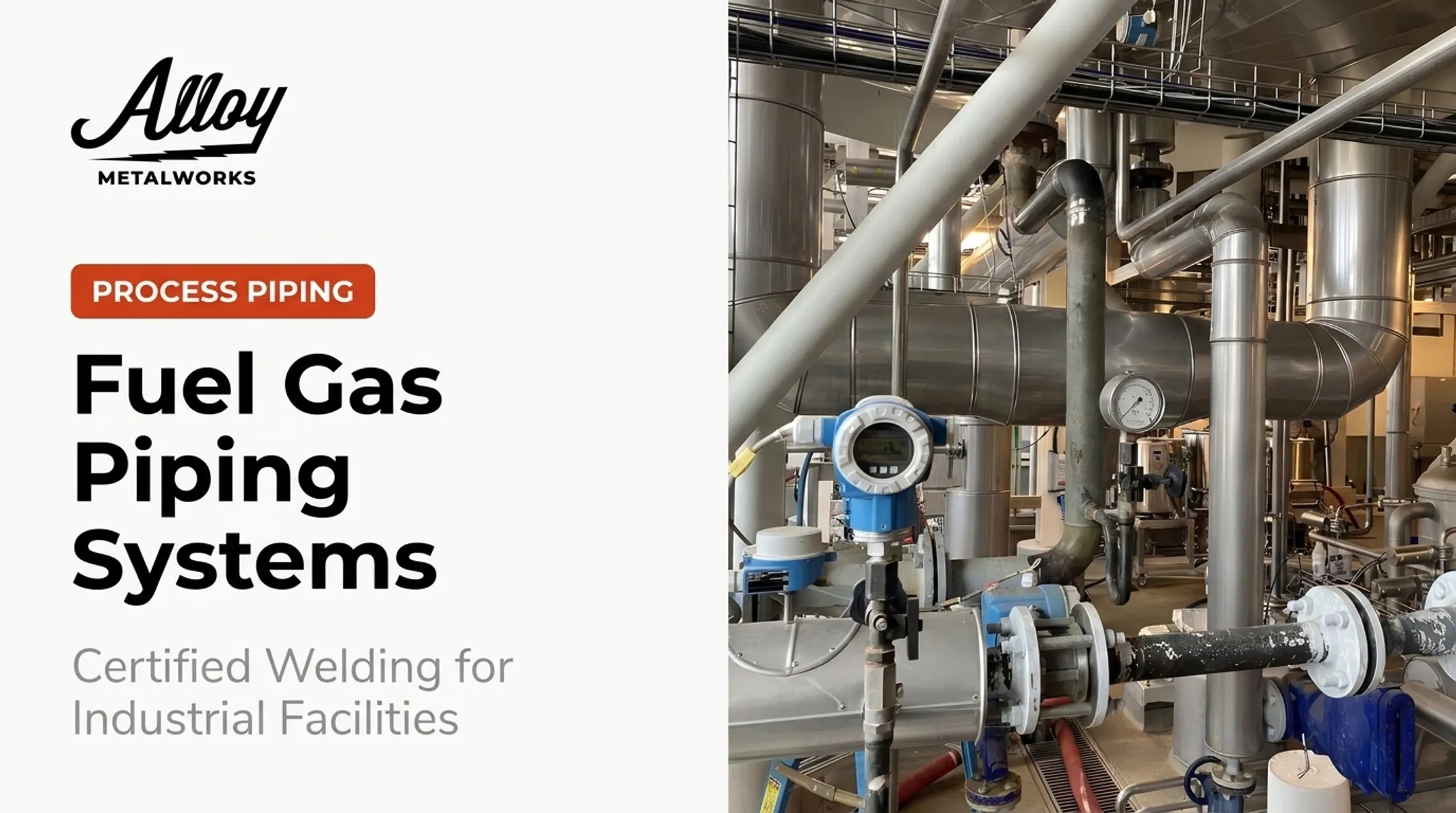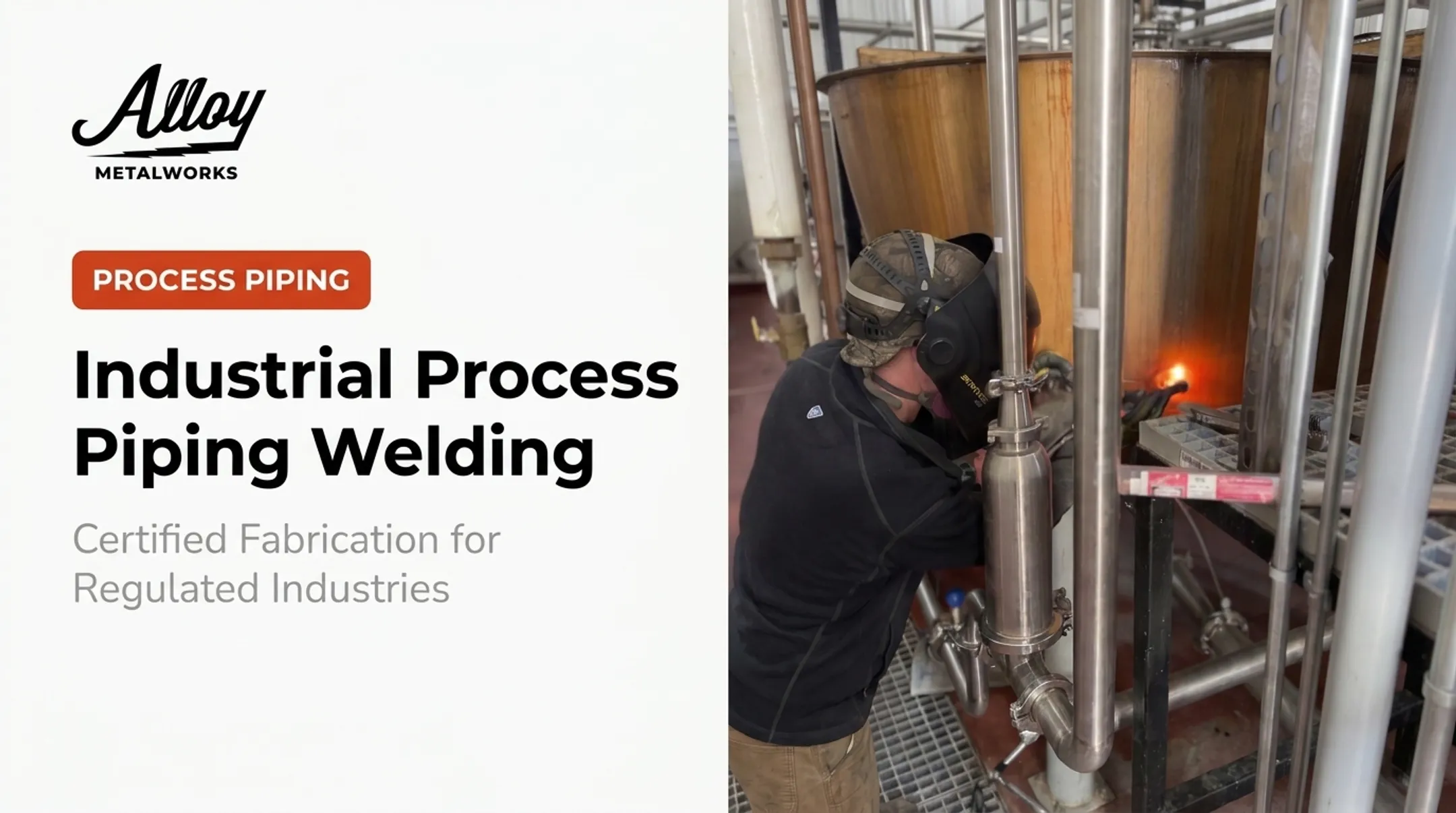

Gas pipe welding spans residential lines, industrial process piping, energy infrastructure, and aerospace propulsion systems — and each comes with different code requirements. This guide covers the welding methods, the codes that govern them, the safety protocols that keep crews alive, and when the work needs a certified fabricator instead of a general contractor.
Key Takeaways
- Pipe material, wall thickness, and pressure rating determine whether TIG, MIG, or Stick welding is the right process
- ASME B31.3, ASME Section IX, and API 1104 govern procedures and welder qualification for gas piping
- Improperly welded gas pipe creates real risks: leaks, fires, and pressure failures
- Size and pressure thresholds, not preference, often dictate welding vs. threading
- Certified welders with documented procedures reduce liability and pass inspection the first time
What Is Gas Pipe Welding?
Gas pipe welding means fusing metallic pipe sections into leak-tight, pressure-rated connections for natural gas, propane, hydrogen, or industrial process gases. It's a distinct discipline from general "gas welding," which refers to oxy-fuel torches used as a heat source.
Here, the pipe itself carries the gas; the welding process (TIG, MIG, or Stick) is just the joining method.
This distinction matters because welding on gas piping carries extra precautions that don't apply to standard structural welds:
- Purging — displacing air or residual gas before hot work begins
- Leak testing — verifying joint integrity before the line enters service
- Controlled atmospheres — preventing oxidation and contamination during the weld, especially on stainless or alloy pipe
OSHA requires that hollow spaces and containers be vented so gases can escape before any cutting or welding begins. Purging is a required, documented step, not an optional precaution.
Applications span a wide range of risk and complexity:
- Residential gas line extensions
- Hydrogen fuel systems for energy startups
- Process gas lines for semiconductor fabs
Alloy Metalworks, for instance, fabricates pressure piping assemblies for energy infrastructure and hydrogen systems where the tolerances and testing requirements go well beyond what a typical gas fitter handles.
Welding Techniques Used for Gas Pipes
Not every gas line calls for the same process. The right choice depends on pipe material, wall thickness, and how critical that joint is to the system's integrity.
Matching Process to Application
| Process | Best For | Key Advantage |
|---|---|---|
| SMAW (Stick) | Field repairs, portable jobs | Low cost, works outdoors, minimal equipment |
| GTAW (TIG) | Stainless, alloy, thin-wall pipe | Precision, clean leak-critical joints |
| GMAW (MIG) | Thicker carbon steel piping | Faster production welding |
| Orbital/automated TIG | Critical, repeatable gas lines | Consistent weld quality, less operator variability |
| SMAW/Stick welding remains the go-to for field repairs. It's portable, doesn't need shielding gas cylinders on-site, and holds up in less-than-ideal outdoor conditions. | ||
| GTAW/TIG welding is the standard for leak-critical joints, particularly on stainless steel or thin-walled pipe. Lincoln Electric notes TIG's use across aerospace, automotive, and energy work, industries where a pinhole leak isn't an option. | ||
| GMAW/MIG welding trades some precision for speed, making it practical for thicker carbon steel gas piping in production settings. | ||
| Across these processes, butt welding is the standard full-penetration joint for pipe segments on the same axis, giving you a joint as strong as the base metal itself. |

Where Orbital Welding Fits
Orbital/automated TIG suits critical gas lines that need identical joints every time. A mechanized torch travels around the tube on a programmed path, so the weld sequence doesn't drift from one joint to the next. Polysoude describes orbital welding as delivering programmed repeatability, real-time parameter monitoring, and automatically generated weld protocols. That documentation helps demonstrate consistency across dozens of identical joints. Alloy Metalworks runs orbital and automated welding programs specifically to reduce that kind of variability on production runs.

Codes, Standards, and Certification Requirements
Gas pipe welding isn't governed by one universal rulebook. Which code applies depends on the piping's service and jurisdiction.
ASME B31.3 (Process Piping) covers materials, design, fabrication, examination, and testing for most industrial and commercial gas piping systems, including hydrogen, chemical, and cryogenic applications.
ASME Section IX is the qualification standard referenced across piping codes. It defines how welders and procedures get qualified, separate from how the pipe itself is built. Every gas piping code eventually points back to it.
API 1104 governs pipeline and transmission systems specifically, covering girth weld qualification and inspection for compression, pumping, and transmission piping.
Before you assume a welder's paperwork covers your job, check these limits:
- Certifications qualify a welder only for a specific process and range of variables
- Codes specify re-qualification intervals if a process goes unused for too long
- API 1104 itself doesn't set a universal certificate expiry; that usually comes from the employer or project spec
- Local/municipal plumbing and gas codes may layer additional requirements on top of ASME for residential and commercial installs
Alloy Metalworks holds ASME Section IX and AWS D-series certifications, which support documentation-backed welds for regulated gas and energy systems. That documentation matters when an inspector or auditor needs proof of qualified procedures and welders.

Safety Considerations When Welding Gas Pipes
Never weld on a live or pressurized gas line without proper isolation, purging, and gas testing. That rule keeps people alive. The OSHA fatality mentioned earlier happened because a line was presumed empty. Presumption isn't verification.
OSHA's welding and cutting standard lays out specific requirements around hot work near gas systems:
- Fire watch required when combustibles sit within 35 feet, or when sparks could reach them
- Mechanical ventilation required in enclosed spaces smaller than 10,000 cubic feet per welder, at a minimum rate of 2,000 cubic feet per minute
- Hot work permits authorizing the job only after the area's been inspected
- Venting and purging of hollow spaces before any cutting or welding starts
Beyond fire and explosion risk, there's metallurgical risk. Welding on pressurized or in-service pipe increases the chance of burn-through, hydrogen cracking, and heat-affected zone (HAZ) embrittlement. Hydrogen cracking happens when hydrogen, a hardened microstructure, and tensile stress interact. TWI's research shows cracks commonly originate right in the HAZ of carbon-manganese steels. In stainless steels, excessive heat can also reduce corrosion resistance through sensitization.

Any gas piping in industrial, energy, or aerospace settings should be handled only by certified professionals. The margin for error is too thin, and the consequences of a failure (fire, explosion, or product loss) are too severe.
Inspection and Quality Verification
A weld is complete only after it clears inspection.
- Visual inspection comes first: bead profile, porosity, and dimensional accuracy against the WPS
- Non-destructive testing (NDT): ultrasonic or radiographic testing finds internal flaws without cutting the weld apart
- Leak and pressure testing: hydrostatic or pneumatic testing confirms the joint holds before the line enters service ASME B31.3 requires leak testing for most piping categories, with hydrostatic, pneumatic, or alternative methods depending on the service. ASME's guidance limits alternative testing to specific situations, like when water would damage insulation or when brittle-fracture risk exists at low temperatures. On one piping-system rebuild Alloy Metalworks handled, the previous contractor's welds failed inspection outright. Weld records, procedures, and welder qualifications were missing entirely. The rebuild stack included:

- Visual inspection
- In-house borescope and dye-penetrant checks
- Certified third-party magnetic particle testing before final review Without traceable documentation, a weld can be structurally sound and still fail an audit.
When to Bring In a Certified Welding Partner
DIY or unqualified welding on gas piping creates real liability risk, especially on industrial and research systems where a failure can affect more than one person.
Bring in a certified fabricator when:
- The project involves specialty alloys — stainless steel, Inconel, Hastelloy, titanium — where heat input and shielding gas control directly affect corrosion resistance
- The system is high-purity or sanitary, requiring controlled atmospheres and validated procedures
- You need audit-ready documentation: qualified WPS, welder qualification records, material traceability, and NDE reports
- Failure consequences are severe: pressure-containing service, combustible gas, hydrogen systems, or aerospace hardware
Alloy Metalworks is a Colorado-based fabricator certified to ISO 9001 and ASME Section IX, delivering inspection-ready, code-compliant welding for aerospace, energy, and advanced manufacturing gas systems. The team welds Inconel, Hastelloy, titanium, and stainless steel with custom inert gas chambers and purge setups built for alloys that demand tight process control—not a general plumbing crew.
Frequently Asked Questions
Can gas pipe be welded?
Yes. SMAW, TIG, and MIG are all used depending on material and pressure requirements, provided the work meets applicable codes like ASME B31.3.
At what pipe size is welding required for gas piping?
Thresholds vary by code and jurisdiction, based on pipe diameter and operating pressure. Confirm requirements with a licensed code official or engineer before assuming threaded fittings will pass.
Is it safe to weld on a natural gas line yourself?
No. Welding on a live gas line risks explosion, even if the line appears empty. Certified professionals should handle any work on pressurized systems.
What certification should a gas pipe welder hold?
ASME Section IX is the primary qualification for most gas piping. Pipeline and transmission work additionally requires API 1104.
How is a welded gas pipe joint tested for leaks?
After visual inspection and NDT, joints go through pressure testing, leak-detection fluid, or an approved gas detector to confirm there's no leakage before the line goes into service.
What's the difference between gas welding and welding gas pipes?
Gas welding refers to using an oxy-fuel torch as a heat source. Welding gas pipes means joining pipe that transports gas, which can use TIG, MIG, Stick, or other arc processes entirely unrelated to oxy-fuel.