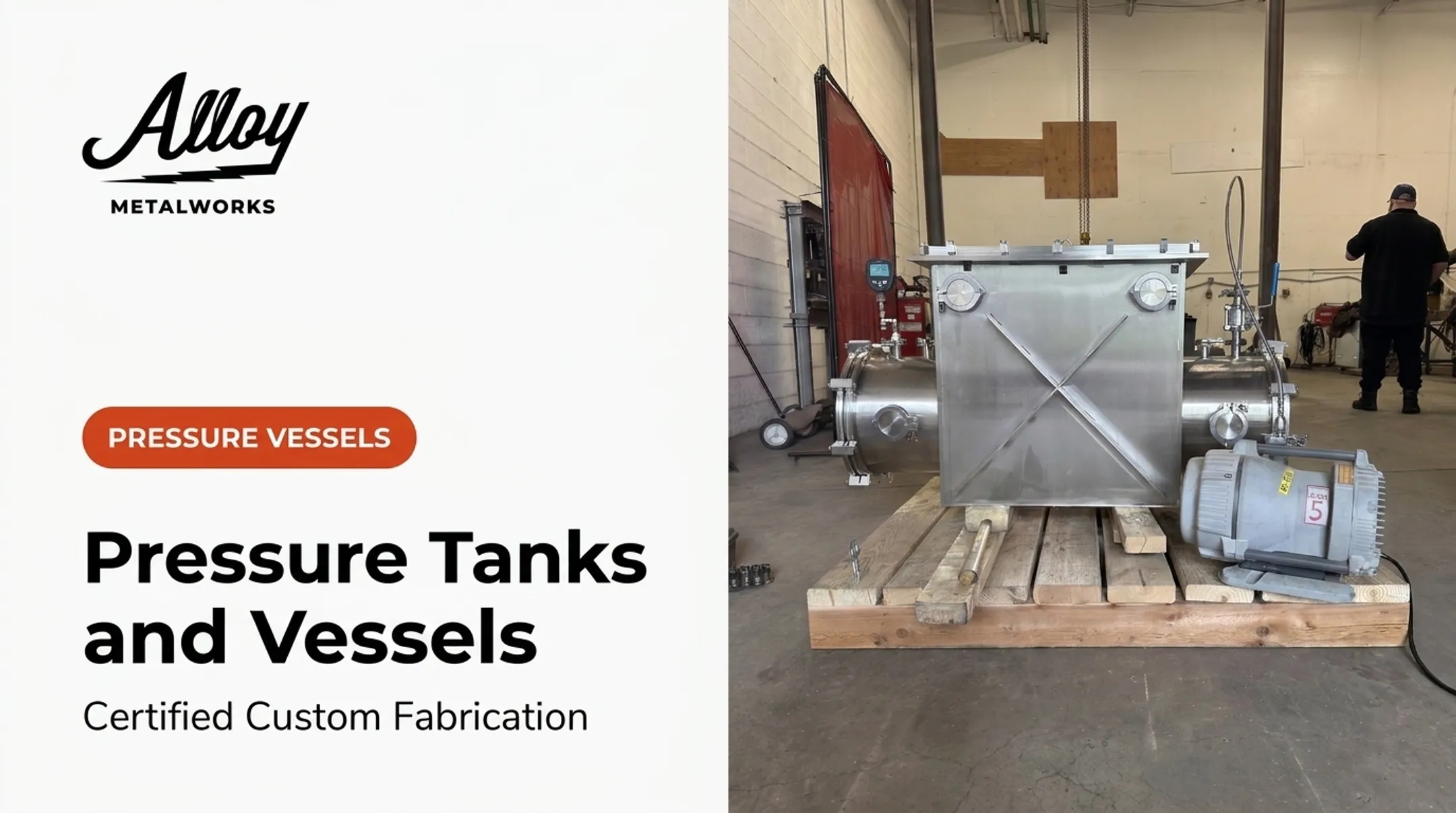

Pressure vessels show up everywhere: aerospace ground support equipment, energy infrastructure, food and pharma processing lines, research reactors. Each application carries its own material, cleanliness, and certification demands. This guide walks through the fabrication process, welding methods, governing codes, material selection, and how to vet a fabrication partner who won't cut corners.
Key Takeaways
- Pressure vessel welds must meet ASME Section IX and the applicable construction code; non-compliance can void certification
- Process selection (SMAW, FCAW, GMAW, GTAW, SAW) depends on material thickness, pressure rating, and sanitary requirements
- Material choice (stainless steel vs. alloys like Inconel or Hastelloy) drives vessel lifespan in real operating conditions
- A fabricator's certifications, documentation, and traceability practices directly reduce your compliance risk
The Pressure Vessel Fabrication Process
Design and Engineering
Everything starts with the design basis: pressure and temperature ratings, vessel category, wall thickness, and nozzle placement. The governing ASME code is locked in at the same time—typically Section VIII, Division 1, for vessels above 15 psig. Skipping this step, or treating it as a formality, creates problems that surface much later, usually during inspection.
Material Selection and Preparation
Once the design is locked, material selection and prep begin:
- Verify heat numbers and mill certs against the code-permitted specification
- Cut and form plate or forgings to spec
- Bevel edges for proper weld joint penetration
- Preserve material identification throughout handling
Welding and Assembly
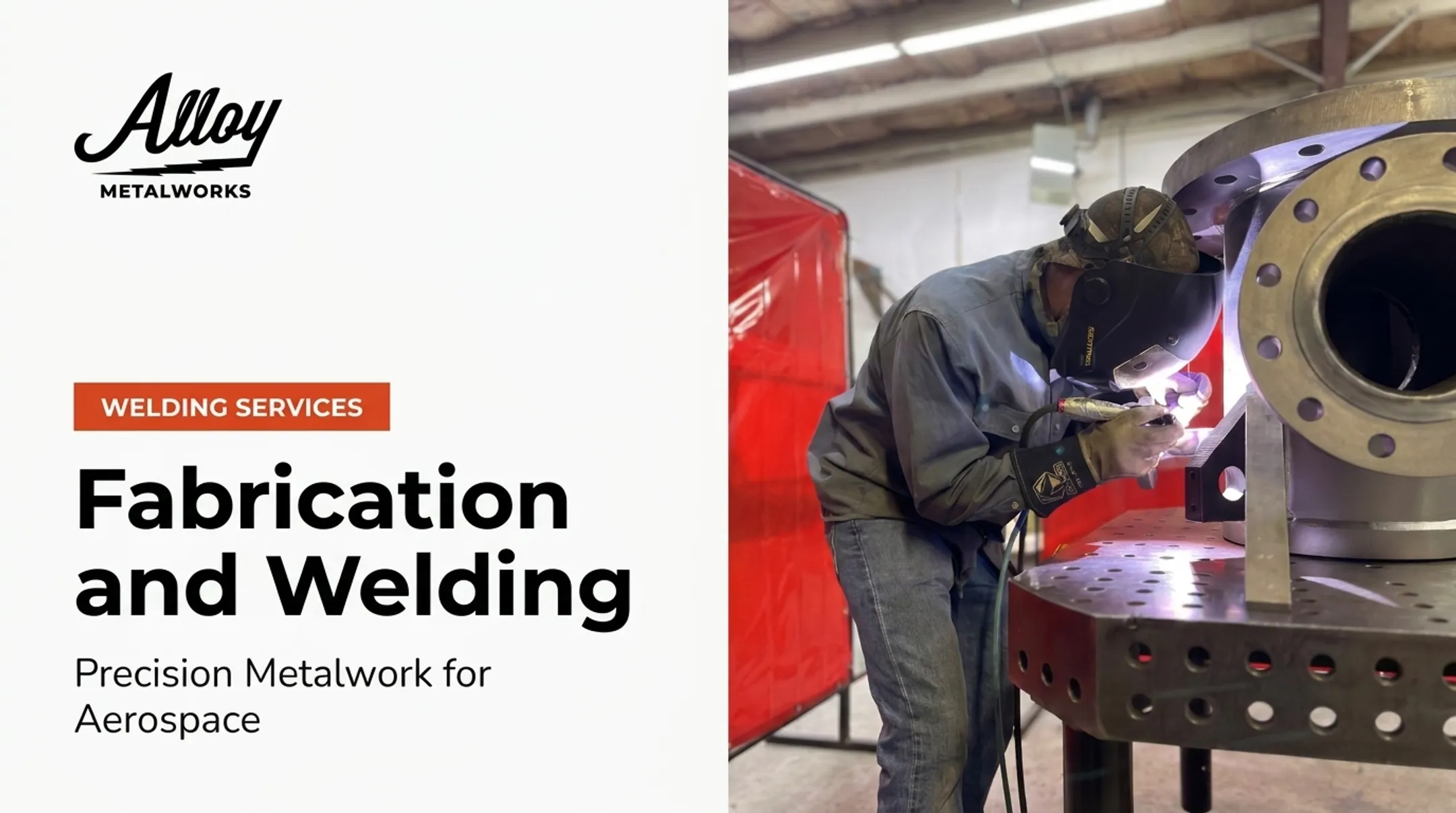
A qualified Welding Procedure Specification (WPS), backed by a Procedure Qualification Record (PQR), governs every pass. Welders must hold current performance qualifications for the specific process, material, and thickness involved. At Alloy Metalworks, the team reviews weld design and compliance before fabrication starts, catching joint-design issues and efficiency gaps while they are still cheap to fix.
Non-Destructive Testing
Common NDE methods for vessel welds include:
- Ultrasonic testing (UT) — detects subsurface flaws in thick sections
- Radiographic testing (RT) — provides a permanent record of internal weld quality
- Magnetic particle testing (MT) — surface and near-surface defects on ferromagnetic materials
- Dye penetrant testing (PT) — surface-breaking flaws on any material
On a recent ASME B31.3 piping rebuild, the shop ran in-house borescope and dye penetrant checks before a certified third-party inspector performed magnetic particle testing. That same layered approach—internal QC plus external verification—applies to vessel weld inspection.
Finishing and Certification
Final steps close out the vessel for inspection and delivery:
- Clean and, where required, passivate (critical for stainless and sanitary systems)
- Verify dimensions against the approved design
- Stamp the nameplate
- Complete the data report package

Types of Welding Used in Pressure Vessel Fabrication
Different joints call for different processes. Here's the practical breakdown:
| Process | Best for | Trade-off |
|---|---|---|
| SMAW | Field repairs, root passes, tight access | Portable, but quality depends heavily on operator skill |
| FCAW | Thick carbon/low-alloy shells | High deposition rate; needs careful hydrogen and shielding control |
| GMAW/MIG | Clean production welds on stainless, aluminum | Fast and consistent, good for semi-automated setups |
| GTAW/TIG | Root passes, thin sections, sanitary and aerospace work | Slower, but unmatched precision and cleanliness |
| SAW | Long, thick circumferential seams | High deposition, but not portable — shop-only |
GTAW earns its place on sanitary and aerospace vessels because it produces the cleanest, most controllable arc — critical when contamination or porosity is unacceptable. Alloy Metalworks uses shop-built orbital GTAW for high-purity work on alloys such as Inconel, where repeatable automated passes beat manual variation.

No process name alone proves compliance. Every one of these still needs a qualified WPS and a welder with current performance qualification under ASME Section IX before it touches a vessel.
Codes, Standards, and Certifications Governing Pressure Vessel Welds
The Foundation: ASME BPVC
ASME Section VIII sets the construction rules: design, fabrication, inspection, testing, and certification for pressure vessels above 15 psig. Section IX governs the welding, brazing, and fusing qualifications that support that construction. They work together; one doesn't substitute for the other.
Where AWS Codes Apply
AWS codes fill in application-specific gaps:
- D1.1 — structural steel (not a pressure vessel construction code)
- D1.2 — structural aluminum (explicitly excludes aluminum pressure vessels)
- D1.6 — structural stainless steel assemblies
- D17.1 — aerospace fusion welding, including Class A requirements for flight-critical hardware
- D18.1 — sanitary tube and pipe welding for hygienic process systems
Documentation That Actually Matters
A welder's certification card only proves they passed a specific test, on a specific date, under specific conditions. It doesn't guarantee every weld they produce afterward meets code. What matters more:
- Current Welding Procedure Specifications tied to the actual job
- Welder qualification records matched to the process and material in use
- Full material traceability from mill cert to finished vessel
- ISO 9001 quality management supporting audit-ready documentation
Alloy Metalworks holds ASME Section IX, AWS D17.1 Class A, AWS D18.1, AWS D1.1/D1.2/D1.6, ISO 9001, and FAA Part 145 QMS. That mix covers the flight-critical, sanitary, and industrial pressure work the shop takes on.

Selecting the Right Materials for Pressure Vessel Fabrication
Operating environment drives material choice more than anything else. Corrosive chemicals, extreme temperature swings, and pressure cycling all narrow the field fast.
Carbon and low-alloy steels still cover a large share of pressure vessel work when corrosion is moderate and cost controls the design. Grades such as SA-516 handle many shop-fabricated vessels; low-alloy options add strength for higher pressure and temperature without moving straight to stainless.
Stainless Steel Grades
- 304/304L — general-purpose corrosion resistance; L grades cut carbon to reduce weld sensitization
- 316/316L — molybdenum addition for chloride and marine service
- Duplex (e.g., 2205) — higher strength and better stress-corrosion cracking resistance than standard austenitics
Specialty Alloys for Extreme Conditions
Nickel-based superalloys step in where stainless can't keep up:
- Inconel (600, 601, 617, 625, 718) — heat and corrosion resistance for petrochemical and aerospace components
- Hastelloy — chemical processing with aggressive acids
- Incoloy 800HT — high-temperature reactor service beyond the stainless range
Alloy Metalworks built an 800HT component for the National Renewable Energy Laboratory rated above 700°C, matching alloy capability to extreme thermal duty.
These alloys are vulnerable to contamination before they ever see service. Carbon-steel tooling, shared abrasive discs, and sulfur-bearing cutting fluids can embed iron particles that trigger corrosion later. Dedicated, labeled consumables and non-ferrous fixturing are required process controls, not optional extras.

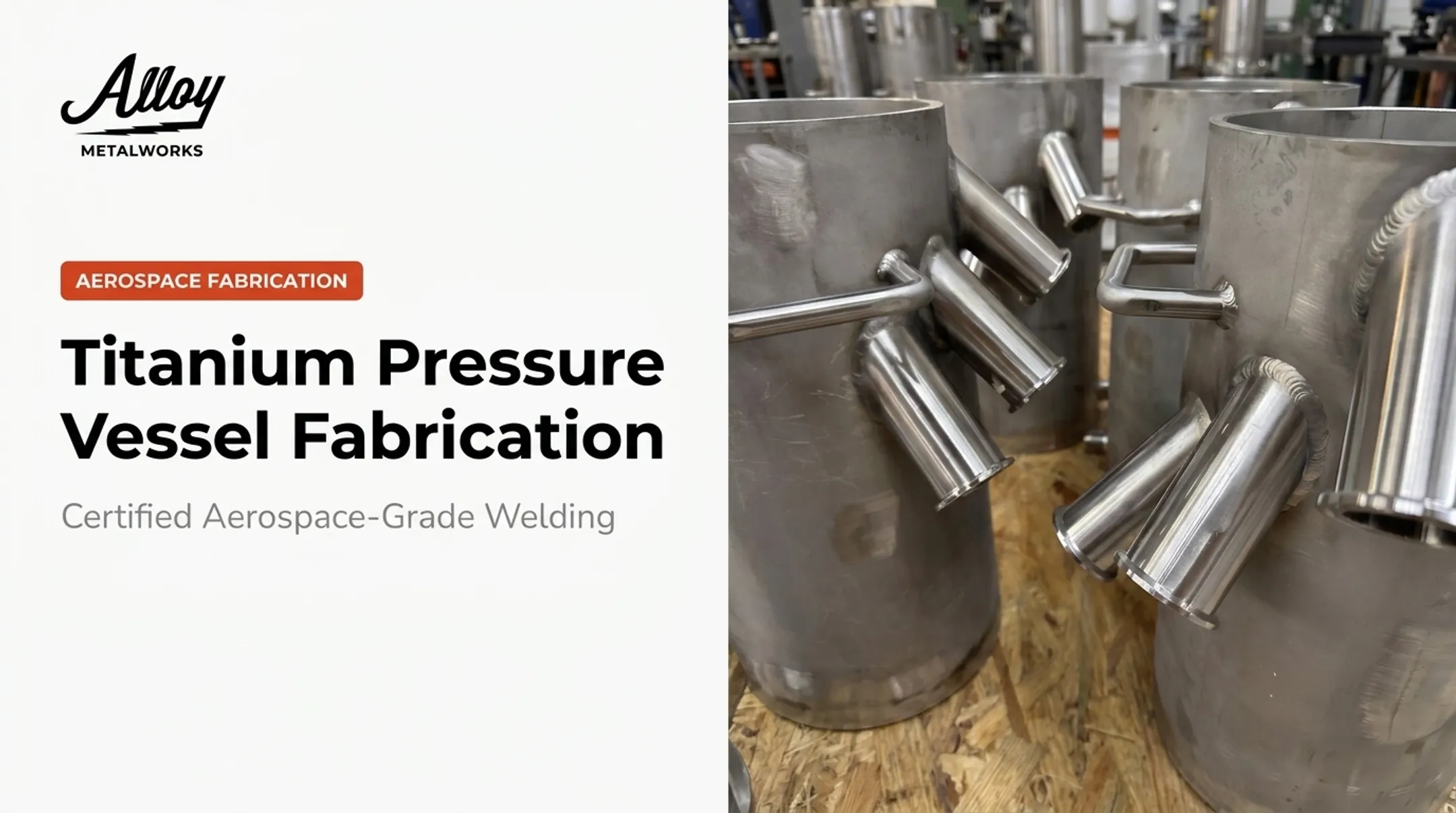
Titanium fits chloride-rich and weight-sensitive pressure applications, including aerospace-adjacent systems. The aerospace titanium market is projected to grow from $3.94 billion in 2025 to $7.56 billion by 2034, according to Fortune Business Insights, a signal of rising specialty-alloy demand in flight-critical and high-performance work.
Choosing a Qualified Pressure Vessel Fabrication Partner
General welding experience and pressure vessel experience are not the same thing. A shop that's great at structural steel or ornamental fabrication may have zero exposure to Section IX qualification, purge control on exotic alloys, or the documentation trail an inspector will demand.
What to Verify Before You Sign a Contract
- Certifications matched to your application: ASME Section IX at minimum; AWS D17.1 for aerospace, D18.1 for sanitary systems
- In-house QC systems: not just final inspection, but in-process checks throughout the build
- Documentation practices: can they produce WPS, PQR, welder quals, and material traceability on request, not after a scramble?
- Engineering collaboration: a fabricator who reviews weld-joint design and flags issues before cutting metal saves you rework later
Alloy Metalworks works this way with aerospace, energy, and research clients: reviewing designs before fabrication starts, running ISO 9001-controlled processes for traceability, and building inspection-ready documentation into every project rather than assembling it retroactively.
That upfront collaboration and audit-ready paper trail is what keeps compliance issues from surfacing months after delivery.
Frequently Asked Questions
Can you weld a pressure vessel?
Only certified welders following a qualified Welding Procedure Specification under ASME Section IX can legally perform pressure vessel welds. Anyone else's work risks rejection during inspection and voided certification.
What are the welding standards for pressure vessels?
ASME's Boiler and Pressure Vessel Code (Section VIII for construction, Section IX for welding qualifications) forms the core requirement. Application-specific AWS codes like D17.1 or D18.1 may also apply depending on the industry.
What types of welding are commonly used in pressure vessels?
SMAW, FCAW, GMAW, GTAW, and SAW are all used depending on material and joint type. GTAW is generally preferred for root passes and sanitary or aerospace applications requiring precision and cleanliness.
Why is pressure vessel welding different from standard welding?
Pressure vessels store energy that can release catastrophically if a weld fails. That risk drives stricter procedure qualification, mandatory inspection, and documentation requirements that standard structural welding doesn't carry.
What certifications should a pressure vessel fabricator have?
Look for ASME Section IX at minimum, plus relevant AWS codes (D17.1 for aerospace, D18.1 for sanitary) and ISO 9001 for quality management. These together indicate both technical qualification and process control.
How is a pressure vessel weld inspected for quality?
Non-destructive testing methods such as ultrasonic, radiographic, magnetic particle, and dye penetrant check for internal and surface defects without damaging the vessel. The specific method depends on material, joint thickness, and the applicable code's acceptance criteria.