
This guide covers what aerospace TIG welding actually involves, why it's specified over other processes, the codes that govern it, and what separates a qualified welding partner from a shop that just owns a TIG machine. We'll also look at what makes this field genuinely different from general fabrication work.
Key Takeaways
- TIG (GTAW) delivers precise control over heat, arc, and filler metal, critical for thin, high-value aerospace materials
- Aerospace TIG welding must follow codes like AWS D17.1 and operate under documented, traceable systems like ISO 9001
- Titanium, Inconel, Hastelloy, and aluminum each demand different shielding gas, purge setups, and technique adjustments
- An AWS D17.1-capable partner cuts compliance risk and prevents costly downstream rework
What Is Aerospace TIG Welding?
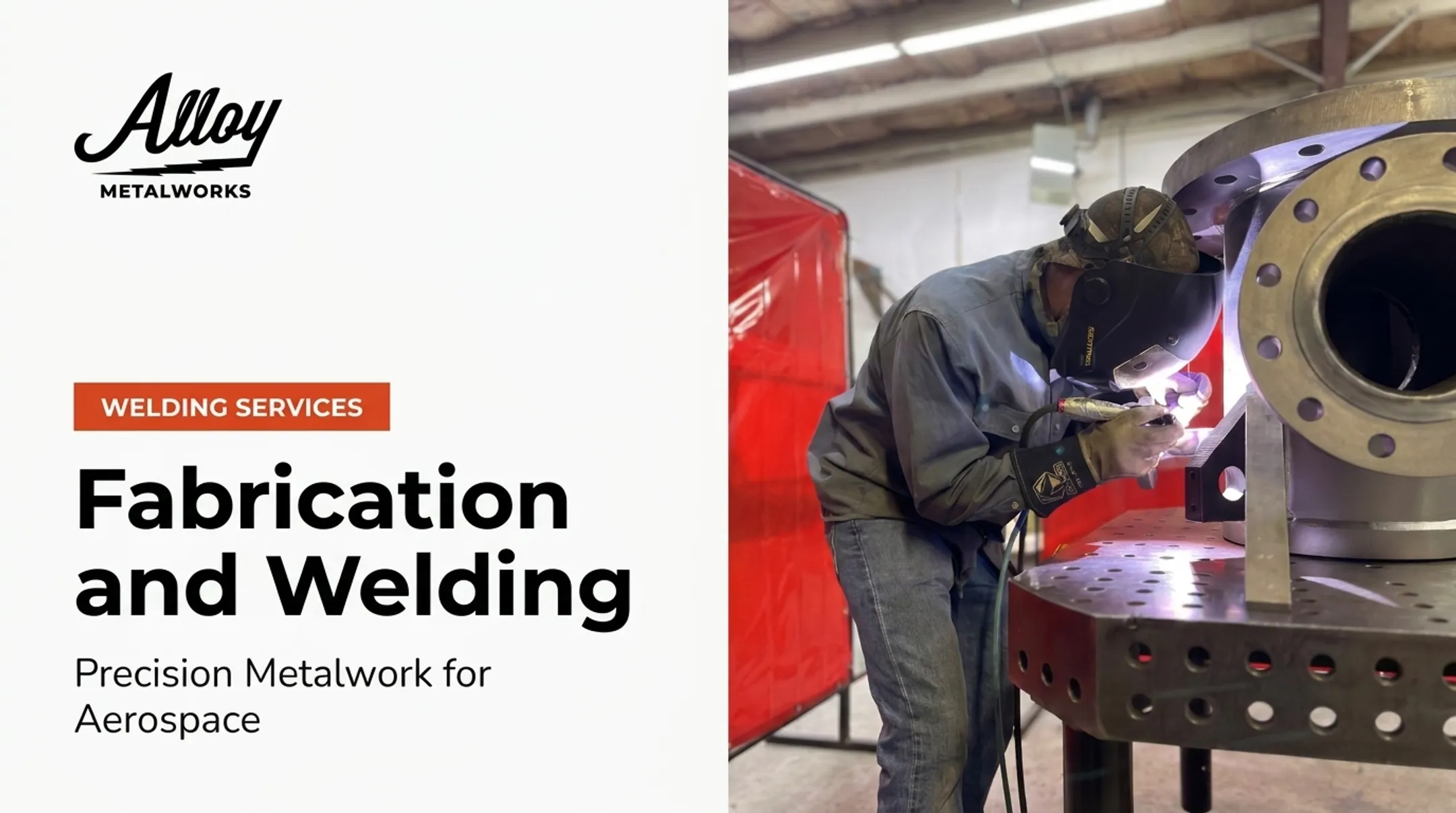
TIG welding (Gas Tungsten Arc Welding, or GTAW) uses a non-consumable tungsten electrode and inert shielding gas to fuse metal with tight, controllable heat input. The welder manually feeds filler metal into the arc, which gives precise control over penetration and bead shape.
Haynes International notes that GTAW is widely used on nickel- and cobalt-based alloys specifically because of this control. NASA White Sands similarly points to TIG when a superior finish is needed on small, delicate components without excessive grinding or rework.
Aerospace TIG welding shows up across a wide range of components:
- Fuselage brackets and structural fittings
- Engine components and combustion hardware
- Fuel and hydraulic lines
- Satellite and spaceflight hardware
- Ground support equipment and test rigs
Aerospace TIG Welding vs. Other Aerospace Welding Methods
TIG is not the only process aerospace manufacturers use. It is the most common choice for precision work on thin, exotic materials.
| Process | Best suited for |
|---|---|
| TIG (GTAW) | Thin-gauge, high-value alloys requiring tight heat control and finish quality |
| Plasma arc | Full-penetration welds on thicker sections needing deep, concentrated heat |
| Resistance welding | High-volume production joints where speed matters more than finesse |
| Friction stir | Joining aluminum structures without melting the base metal |

Each process fills a different role. TIG is typically selected when tolerances are tight and the base metal cannot tolerate high heat input.
Why TIG Welding Is Critical for Aerospace-Grade Materials
Aerospace parts are frequently built from thin-gauge titanium, Inconel, Hastelloy, stainless steel, and aluminum. These materials are chosen for strength-to-weight ratio, not weldability. These alloys warp, crack, or lose metallurgical integrity fast when heat isn't controlled.
TIG's low-distortion arc is what makes welding these materials feasible at all. The process lets a welder dial in heat input precisely enough to fuse thin sections without blowing through them or creating a heat-affected zone that weakens the surrounding metal.
Titanium and nickel alloys add another challenge: they oxidize fast when exposed to atmosphere while hot. Purge gas and inert chambers are part of the weld itself, not optional extras. Alloy Metalworks builds custom inert gas chambers and purge setups specifically for precision titanium welding, because standard shop ventilation isn't enough to prevent contamination.

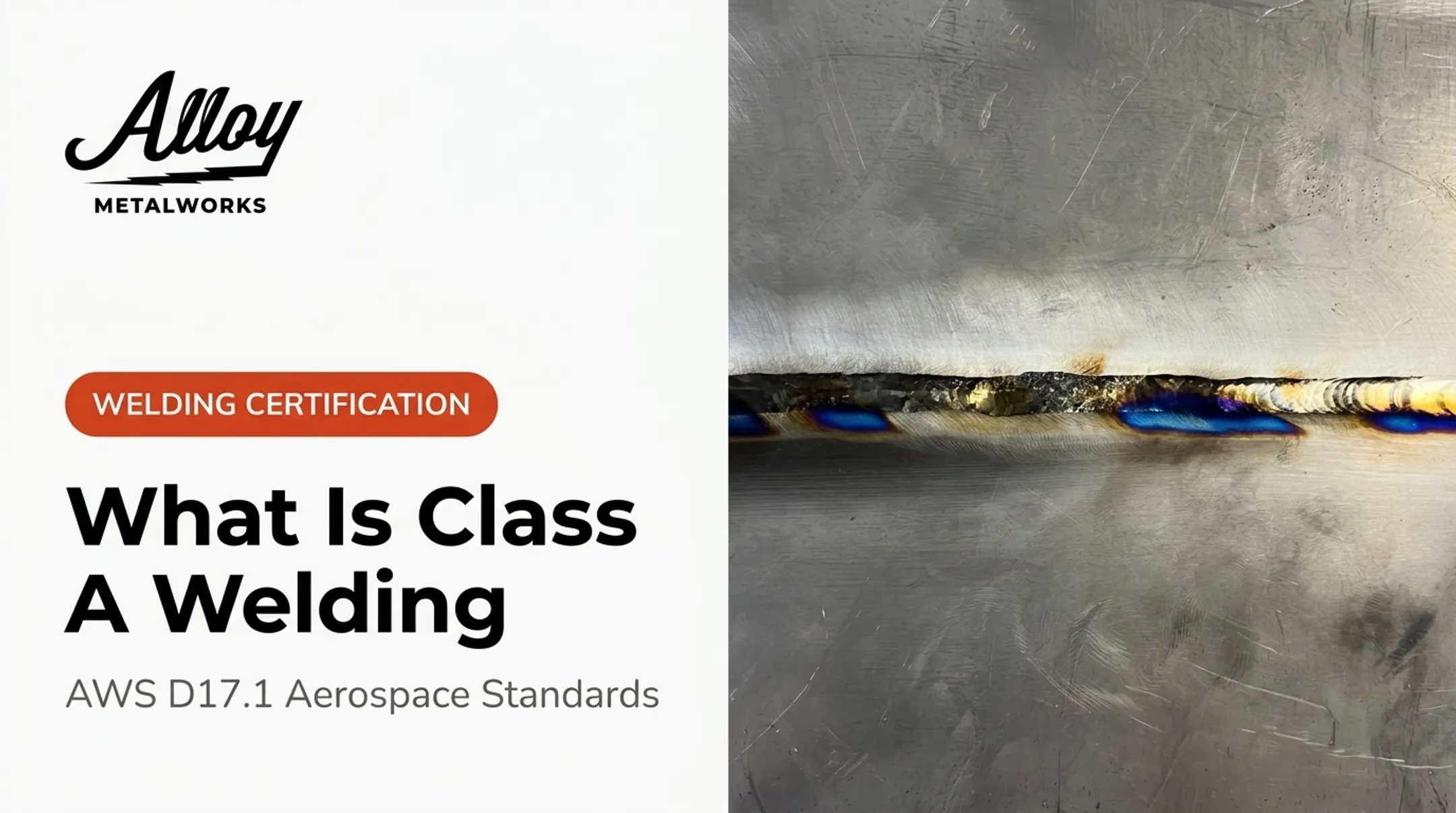
Under AWS D17.1 Class A, the acceptance bar is unforgiving:
- Minor visual imperfections can trigger immediate rejection
- Contamination signs alone can disqualify a part, even after radiographic or destructive testing passes
- A single overlooked flaw means the part should never have shipped
For alloys like Inconel 617, the margin is even tighter. Too much heat risks distortion and metallurgical compromise; too little sacrifices fusion entirely. Getting there often means ultra-high-frequency pulse settings that keep a stiff, focused arc at low heat input, precision general fabrication rarely demands.
Standards, Codes, and Certifications Governing Aerospace TIG Welding
Aerospace TIG welding doesn't operate on shop reputation alone. It runs on documented codes and third-party oversight.
AWS D17.1 is the primary specification for fusion welding in aerospace. It covers design, qualification, fabrication, inspection, and repair of titanium, aluminum, nickel superalloys, and other specialty materials.
Class A, reserved for flight-critical hardware, carries the strictest acceptance criteria in the standard.
Other key codes and verification methods include:
- ASME Section IX — qualifies welding procedures and individual welder performance
- FAA Part 145 — governs certificated repair stations, including trained personnel, QC documentation, and inspection systems
- ISO 9001 — quality management system standard for documentation, traceability, and audit readiness
- NDT methods (radiographic, dye penetrant, ultrasonic) — verify weld integrity; the required method depends on the part and governing spec
Alloy Metalworks operates under ASME Section IX and AWS D17.1 Class A for flight-critical hardware, backed by ISO 9001 QMS and FAA Part 145 QMS. That combination matters: a QMS certificate alone does not prove a weld procedure or welder is qualified. Each credential covers a different piece of the compliance puzzle.

The Aerospace TIG Welding Process: Step-by-Step
Aerospace TIG welding follows a controlled sequence long before the arc ever strikes.
- Spec and procedure development — Engineers interpret blueprints and develop a weld procedure specification (WPS) matched to the material, joint type, and acceptance class before any fabrication begins.
- Surface prep and fit-up — Thin, high-value materials need meticulous cleaning with non-ferrous or protected fixtures, approved cleaning fluids, and low-chloride water so carbon-steel tooling cannot embed iron particles into alloy surfaces.
- Controlled-environment welding — Titanium and nickel alloys are welded inside inert gas chambers or with dedicated purge setups to keep oxygen and contaminants away from the hot weld zone.
- Inspection and documentation — Every weld is checked against the applicable acceptance criteria, with records tracking shielding-gas purity, torch angle, travel speed, and joint cleanliness for full traceability.

That documentation protects the part in service. Excessive heat input or inadequate shielding gas can oxidize an alloy's protective passive layer, a defect that may not appear until the component is flying.
How Hard Is Aerospace TIG Welding? Skills and Challenges
Aerospace TIG welding demands more than steady hands. It requires metallurgical judgment, because margins for error are close to nonexistent.
Common challenges welders face:
- Welding thin sections without burn-through
- Managing heat-affected zones on heat-sensitive alloys
- Producing consistently x-ray-clean welds under Class A scrutiny
- Adjusting technique in real time when travel speed or torch angle drifts
Sometimes the fix is small but exacting. One titanium sample failed initial inspection until travel-speed and torch-angle adjustments brought it into compliance—passing both destructive and non-destructive testing under AWS D17.1 Class A criteria on the next attempt. In aerospace TIG work, those tiny variables carry outsized consequences.
Becoming proficient typically takes years of hands-on practice, followed by formal qualification testing under codes like AWS D17.1. There's no shortcut through a certificate alone. Continuity and process-specific experience matter just as much.
Choosing a Qualified Aerospace TIG Welding Partner
Not every shop that TIG welds is equipped for aerospace work. Here's what actually separates a qualified partner from a general fabricator:
- AWS D17.1 Class A, ASME Section IX, and current welder performance qualifications
- FAA Part 145 repair station certification when regulated aircraft work is involved
- ISO 9001-controlled processes that stay documented, traceable, and audit-ready from kickoff through final inspection
- Engineering support across weld procedure development, distortion control, and joint design—not execution alone
Alloy Metalworks pairs those credentials with hands-on work in Inconel, Hastelloy, titanium, and stainless steel. The team supports aerospace, space technology, and advanced energy organizations that need inspection-ready parts without repeat rework cycles. Ask for procedure ownership, full traceability, and a documentation package your QA team can defend at audit.
Frequently Asked Questions
What does an aerospace welder do?
An aerospace welder fabricates and repairs flight-critical parts by interpreting engineering blueprints and following strict weld procedures. Their work must meet documented inspection and traceability standards at every stage.
What type of welding is used in aerospace?
TIG (GTAW) is the most common process for thin-gauge, exotic alloys due to its precise heat control. Plasma arc, resistance, and friction stir welding are used for specific applications where their strengths fit better.
How hard is aerospace welding?
It has a high skill ceiling with near-zero tolerance for defects. Welders typically need years of hands-on practice plus formal certification testing to work on flight-critical hardware.
What certifications are required for aerospace TIG welding?
Key credentials include AWS D17.1 (often Class A for flight-critical parts), ASME Section IX for procedure and welder qualification, and FAA Part 145 status for regulated repair work.
Why is TIG welding preferred over MIG for aerospace parts?
TIG offers far more precise heat control, which is essential on thin, high-value materials prone to warping or burn-through. MIG works well for faster production welds but lacks that same fine control.
What materials are commonly TIG welded in aerospace applications?
Titanium, Inconel, Hastelloy, aluminum, and stainless steel are the most common. Each requires its own shielding gas setup and technique adjustments to avoid oxidation or heat damage.