
Process piping welding isn't the same trade as cross-country pipeline welding. It's governed by different codes, different qualification requirements, and a much tighter margin for error since these welds live inside occupied facilities.
This guide breaks down the processes, codes, positions, defects, and inspection methods that define quality process piping work, plus what to look for in a welding partner who can actually deliver it.
Key Takeaways
- Process piping welding falls under ASME B31.3, not API 1104, which changes qualification and documentation requirements
- GTAW (TIG) remains the standard for root passes on critical piping and exotic alloys
- Welder and procedure qualification under ASME Section IX matters more than shop equipment
- Inspection-ready fabrication with proper documentation prevents costly rework and schedule delays
What Is Industrial Process Piping Welding?
Process piping welding joins pipe sections inside refineries, chemical plants, labs, power stations, and similar facilities so fluids and gases can move under pressure. It's a different animal from pipeline welding, which covers long-distance transmission lines running for miles between compressor stations.
ASME B31.3 covers this exact scope: materials, design, fabrication, assembly, erection, examination, inspection, and testing for piping in petroleum refineries, chemical and pharmaceutical plants, power generation, and cryogenic facilities. Long-distance transmission piping falls under a separate code entirely (API 1104).
Most process piping welds are circumferential butt joints, also called girth welds. These require full penetration and, in regulated industries, full documentation that traces each weld to a qualified procedure and welder.
Categories of Piping by Service
Service conditions dictate weld requirements:
- Normal fluid service — standard industrial applications with typical pressure and temperature ranges
- Category M service — hazardous fluids where a leak poses serious health risk; carries additional welding and inspection restrictions
- High-purity and sanitary service — pharmaceutical, biotech, and food-grade systems where contamination control drives weld finish and joint design
A sanitary stainless line moving pharmaceutical intermediates gets welded and inspected very differently than a carbon steel line moving process water. The fluid dictates the code path.
Welding Processes Used in Process Piping
Process piping shops rely on a handful of arc welding processes, chosen based on material, wall thickness, and where the work happens.
- SMAW (stick) — portable and self-shielded, so it works well for field repairs and thicker sections where you can't control the environment
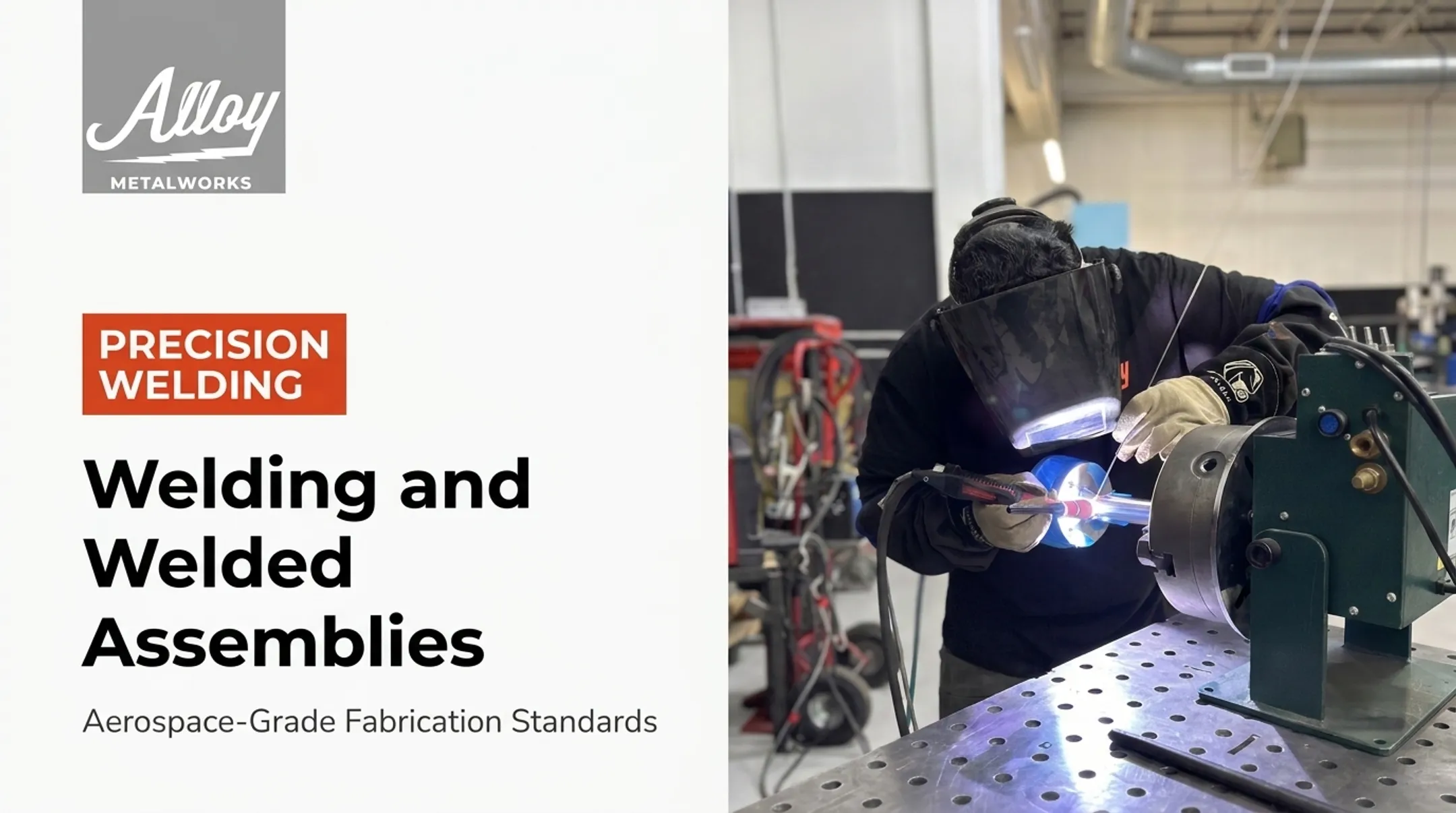
- GTAW (TIG) — the highest-precision option, required for root passes on critical or high-purity piping and essential for exotic alloys like titanium, Inconel, and Hastelloy
- GMAW (MIG) — faster deposition, best suited to controlled shop environments rather than windy field sites
- FCAW — tolerant of wind and minor contaminants, a solid choice for heavier pipe welded outdoors
- SAW — high deposition rates for long, straight seams on large-diameter shop welds
Deposition efficiency varies by process, and the gap matters on large jobs where labor hours add up fast. The Fabricator reports:
| Process | Deposition Efficiency |
|---|---|
| SAW | ~99% |
| GTAW | ~99% |
| GMAW | 92–98% |
| FCAW | ~87% |
| SMAW | ~65% |

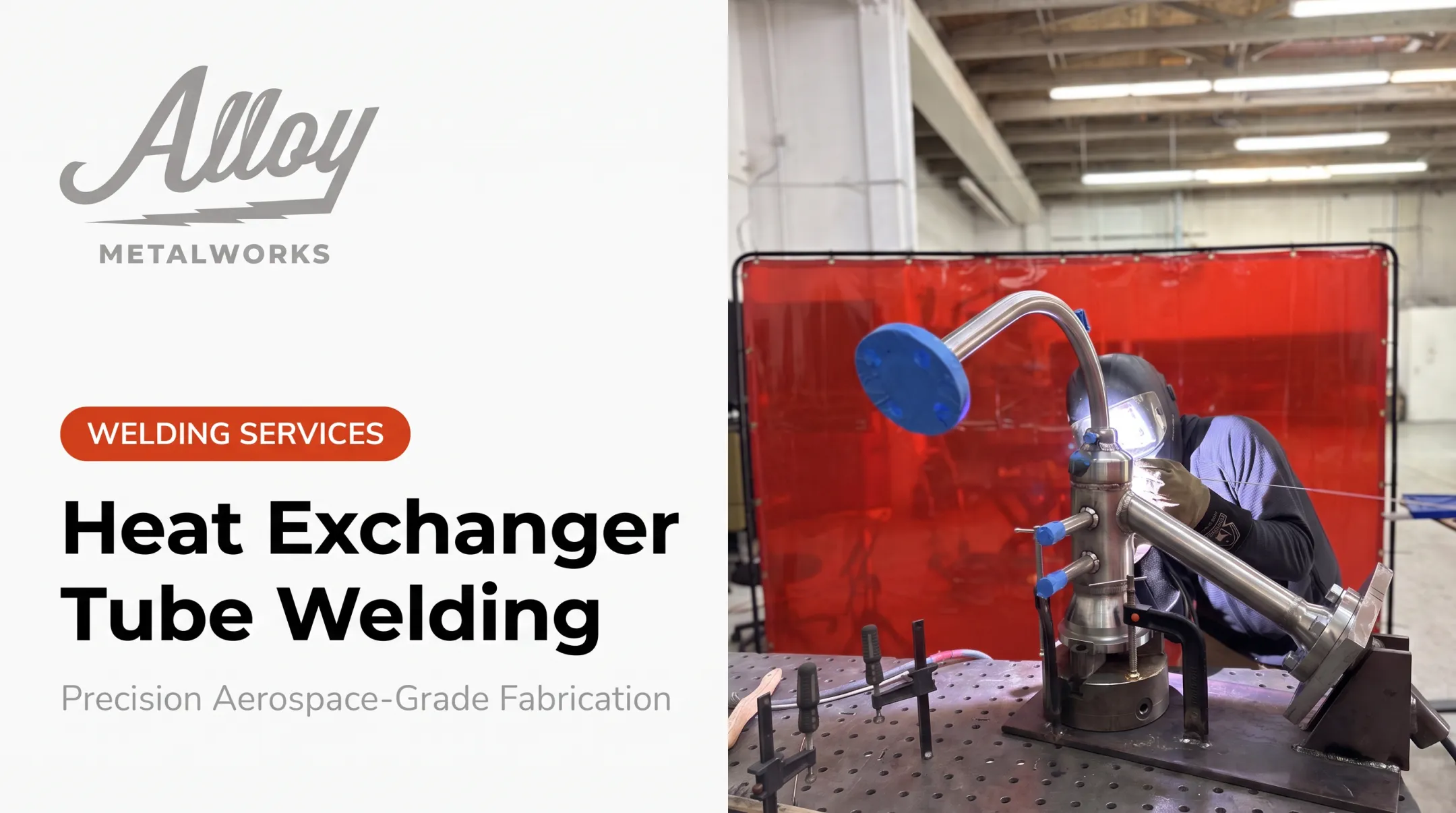
At Alloy Metalworks, GTAW is the workhorse process for exotic alloy piping. Titanium welding demands custom inert gas purge chambers to keep oxygen away from the weld pool. Skip that step and you get a brittle, discolored joint that fails corrosion testing.
The shop has welded Inconel 600, 601, 617, 625, and 718, along with Hastelloy and titanium Grades 2 and 7, for reactor systems and hydrogen infrastructure clients.
Codes and Standards Governing Process Piping Welding
ASME B31.3 is the primary code for in-plant process piping. It's distinct from API 1104, which governs pipeline transmission systems. Confusing the two is a common (and costly) mistake for facilities that assume one code covers everything.
Section 328.2.1 of B31.3 requires that welding procedures be qualified according to ASME Section IX, which requires two separate qualifications:
- WPS/PQR (procedure qualification) — proves a welding procedure produces a sound joint under specific conditions
- WPQ (welder qualification) — proves an individual welder can execute that procedure correctly
These aren't interchangeable. A qualified procedure doesn't mean every welder using it is automatically qualified, and vice versa.
For sanitary and hygienic stainless systems, AWS D18.1 governs food, beverage, and pharmaceutical piping, covering qualification, fabrication, visual examination, and documentation standards specific to hygienic service.
Code compliance still depends on traceability. Auditors and inspectors typically require:
- Material certifications
- WPS records and welder qualification logs
- NDT reports tied to specific weld numbers
Alloy Metalworks maintains ASME Section IX, AWS D18.1, and ISO 9001 credentials to support that documentation trail for regulated work in aerospace, energy, and pharma.
Positions, Passes, and Preparation
Before anyone strikes an arc, the pipe needs proper prep:
- Cleaning — removing mill scale, oil, and contaminants from the joint area
- Beveling — cutting the correct edge angle for weld penetration
- Fit-up and alignment — ensuring pipe ends line up within tolerance before tacking
Skip any of these steps and you're setting up for lack of fusion or misalignment defects later.
The Four Welding Positions
Pipe welding positions range from straightforward to difficult:
| Position | Description | Difficulty |
|---|---|---|
| 1G | Pipe rotated, weld stays flat | Easiest |
| 2G | Pipe fixed vertically | Moderate |
| 5G | Pipe fixed horizontally | Hard |
| 6G | Pipe fixed at 45 degrees | Hardest |
A 6G qualification covers all other positions, because 6G combines flat, vertical, and overhead welding in one continuous joint.

Multi-Pass Sequence
Once position and fit-up are set, thicker walls still need multiple passes to fill the joint:
- Root pass — establishes penetration and fuses the inside edges
- Fill passes — build joint thickness to match wall requirements
- Cap pass — the final visible layer, blended smooth to meet reinforcement limits
Wall thickness drives pass count directly. A thin sanitary tube might need just a root and cap, while a heavy-wall reactor pipe could require six or more fill passes.

Common Defects and How Welds Are Inspected
Even experienced welders produce defects when procedures, prep, or technique fall short. Common defects include:
- Lack of fusion — weld metal doesn't properly bond to base metal, often from insufficient heat or poor technique
- Porosity — gas pockets trapped in the weld, usually from contamination or shielding gas problems
- Cracking — can occur during cooling, especially in high-carbon or exotic alloys with rigid restraint
- Undercut — a groove melted into base metal at the toe of the weld, weakening the joint
- Slag inclusion — trapped slag from flux-based processes like SMAW or FCAW
Catching these before a system goes into service requires nondestructive testing (NDT):
- Visual testing (VT) — direct inspection with the naked eye or optical aids
- Radiographic testing (RT) — X-rays or gamma rays image internal weld structure
- Ultrasonic testing (UT) — high-frequency sound waves detect surface and subsurface flaws
- Magnetic particle testing (MT) — finds surface and near-surface flaws in ferromagnetic material
- Liquid penetrant testing (PT) — reveals surface discontinuities in nonporous materials
On one piping-system rebuild, Alloy Metalworks ran in-house borescope and dye penetrant testing before bringing in a certified third-party inspector for visual and magnetic particle testing to ASME B31.3 standards. That layered approach catches problems early, before they become a failed inspection and a stalled schedule.

Choosing a Qualified Process Piping Welding Partner
A welder's certification card doesn't guarantee the weld in front of you meets code. A certification test covers a narrow range of variables at one point in time. It says nothing about whether the shop maintains documented procedures, material traceability, or ongoing qualification programs.
Alloy Metalworks encountered this firsthand on a piping-system rebuild. The previous contractor's welds failed inspection, and when asked for documentation on the welds, procedures, or welder qualifications, there wasn't any. Alloy rebuilt the system on-site and had it inspected to ASME B31.3 standards, with full documentation this time.
What actually determines weld reliability:
- Documented, qualified WPS/PQR records for each procedure used
- Current welder qualifications tied to the specific process and position
- Material and filler-metal traceability
- Engineering collaboration that bridges design intent with buildable, inspection-ready parts
That last point carries more weight than it first appears. Alloy Metalworks works directly with engineers and project managers on:
- Weld procedure development
- Heat-input and distortion control
- Joint design support from concept to inspection-ready hardware
That collaboration helped the company earn a spot on the National Renewable Energy Laboratory's approved vendor list. The qualifying work included an Alloy 800HT component rated above 700°C in a thermochemical reactor. Utility Global has also praised the shop's turnaround time on custom piping and fittings.
Specialty alloy expertise matters just as much. Partner selection should also weigh materials capability. Titanium, Inconel, and Hastelloy show up constantly in advanced energy and aerospace piping, and each behaves differently under heat:
- Wrong heat input or filler choice can fail inspection on the spot
- Poor procedure control can strip corrosion resistance for the life of the system
Frequently Asked Questions
Which type of welding is used in piping?
Process piping typically uses arc welding processes: SMAW, GTAW, GMAW, FCAW, and SAW. The choice depends on material, wall thickness, and whether the work happens in a controlled shop or an exposed field environment.
What is the difference between pipe welding and pipeline welding?
Pipe welding joins piping inside plants and facilities under ASME B31.3. Pipeline welding covers long-distance transmission lines under API 1104. They're separate codes with separate qualification requirements.
What certifications should a process piping welder hold?
ASME Section IX qualification is the baseline for procedure and welder qualification. AWS D18.1 applies for sanitary stainless systems. Shops often pair these credentials with ISO 9001 for quality management and traceability.
What is the hardest pipe welding position?
6G, where the pipe is fixed at a 45-degree angle. It combines flat, vertical, and overhead welding in one continuous joint, which is why 6G qualification covers all other positions.
How are process piping welds inspected before service?
Visual inspection is the first step, followed by nondestructive testing methods like radiographic and ultrasonic testing to confirm internal soundness. Magnetic particle and liquid penetrant testing catch surface flaws.
Can exotic alloys like titanium or Inconel be welded for process piping?
Yes, typically through GTAW with inert gas purging to prevent oxidation and contamination. Custom purge chambers help maintain the corrosion resistance these alloys are chosen for.