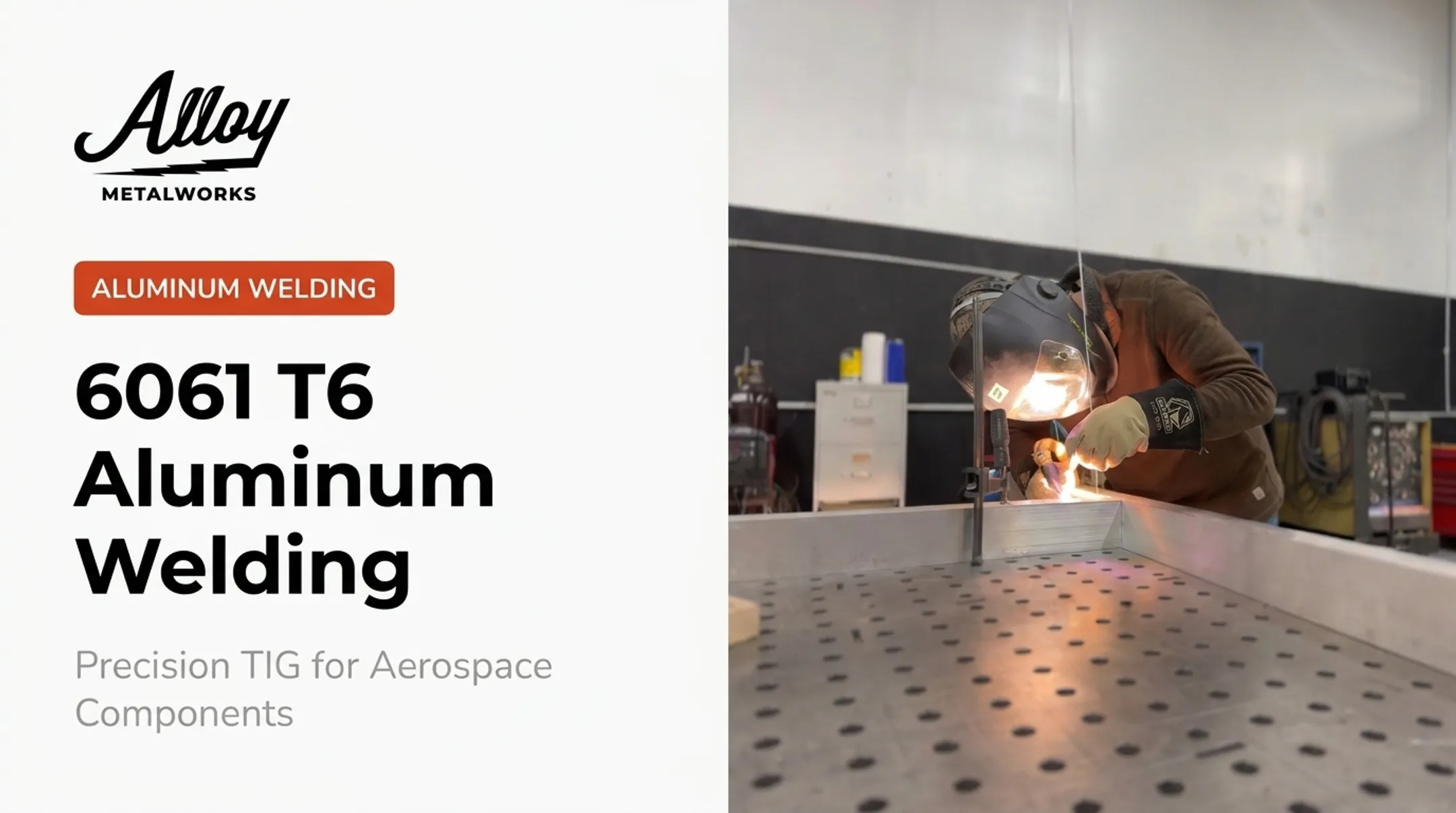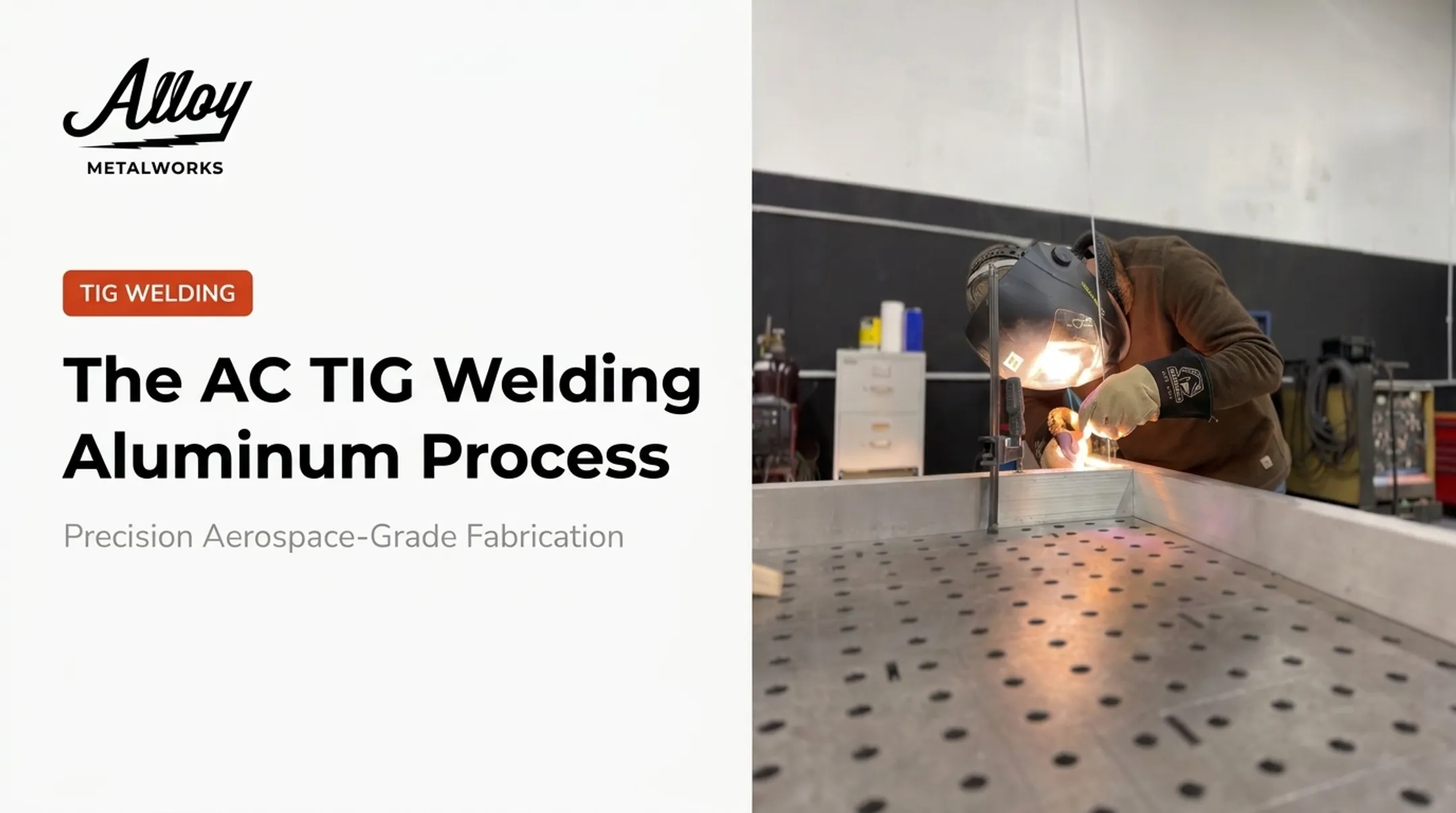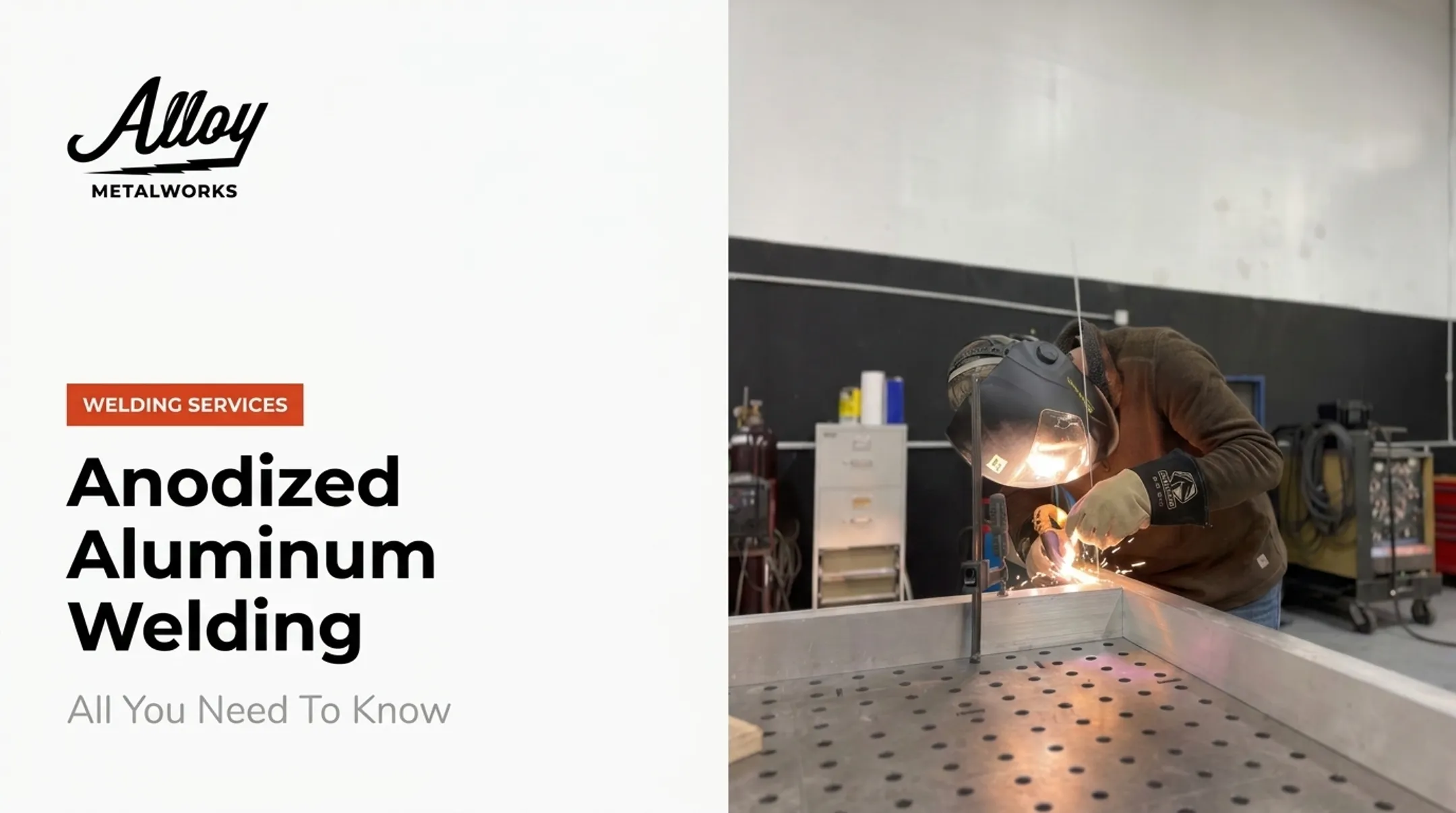

Many welders struggle the first time they run a bead on thin-gauge 3003. Porosity shows up. The sheet burns through before the puddle even forms. The oxide layer refuses to cooperate. These aren't signs of a bad welder — they're signs of not understanding 3003's specific chemistry and thermal behavior.
This guide covers what actually matters: the alloy's properties, TIG setup and parameters, a step-by-step process, common failure points, filler metal selection, and when the job calls for a certified fabrication partner instead of a DIY attempt.
Key Takeaways
- 3003 TIG-welds cleanly (good fluidity, low crack risk) but needs careful oxide prep and heat control.
- Filler choice (1100 or 4043) and shielding gas purity directly determine weld strength and appearance.
- HAZ strength loss is permanent because 3003 can't be heat-treated.
- Code-compliant or flight-critical 3003 welds belong with an AWS-certified shop with documented procedures.
What Is 3003 Aluminum and Why TIG Weld It
3003 is an aluminum-manganese alloy — roughly 1.0-1.5% manganese, plus small amounts of copper, iron, and silicon. That manganese content gives it moderate strength, excellent corrosion resistance, and strong formability compared to pure aluminum.
Here's the catch: 3003 is non-heat-treatable. Unlike 6061 or 2024, you can't strengthen it through aging or solution heat treatment. All of its usable strength comes from cold working, expressed through tempers ranging from O (fully annealed) to H18 (fully hardened).
That fact drives everything about how you weld it. Any heat applied during welding will anneal the material in the heat-affected zone, and there's no post-weld heat treatment that brings that strength back.
Why TIG over MIG or gas welding?
- Precise heat control — critical since 3003 sheet is often thin
- Cleaner welds with less spatter
- Better suited to the thin-gauge material common in HVAC ducts, tanks, and sheet metal parts
- Easier puddle control on complex or tight joints
TIG (GTAW) gives you the heat and puddle control needed to fuse thin 3003 cleanly without burn-through.

TIG Welding Setup and Parameters for 3003 Aluminum
Polarity and AC Balance
Aluminum TIG welding requires AC current, not DC. Here's why: aluminum's oxide layer melts at roughly 3,700°F, while the base metal melts around 1,190°F. That's a massive gap. AC's positive half-cycle breaks up and removes that oxide (cleaning action), while the negative half-cycle drives penetration into the base metal.
On modern inverter machines, you'll adjust balance to control how much cleaning versus penetration you get:
- Dirty or older aluminum: lower balance settings (around 65%) for more cleaning action
- Clean, well-prepped material: higher balance (around 80%) for more penetration and less heat waste
AC frequency mostly affects arc width and directional control, not oxide removal — don't confuse the two settings.
Tungsten and Amperage
- Tungsten type: Zirconiated tungsten is a solid choice for aluminum, offering good arc stability and starting characteristics. Pure tungsten still works but isn't the default anymore on inverter machines.
- Electrode diameter (1.6mm): Under 0.8mm / 0.035" thickness, under 50A
- Electrode diameter (2.4mm): 0.8–3.2mm / 0.035"–0.125" material, roughly 50–150A
Treat these as starting points. Adjust for joint design, fit-up, and how fast heat builds in the part.
Shielding Gas
100% argon is the standard choice for nearly all 3003 TIG work. Save argon/helium blends for thicker sections where you need extra heat input to keep up penetration — helium can actually destabilize the AC arc if you overdo it on thinner material.
Cleaning: Non-Negotiable
Skip cleaning, and the oxide traps contamination right in your weld pool.
Before every weld:
- Degrease the joint area thoroughly
- Remove oxide with a dedicated stainless-steel brush (never one used on other metals)
- Weld promptly after cleaning — oxide reforms within hours
Step-by-Step TIG Welding Process for 3003 Aluminum
1. Confirm material and job requirements. Check temper, thickness, joint design, and whether a governing code or WPS applies before you strike an arc.
2. Clean the joint. Degrease, then mechanically remove oxide immediately before welding — not the night before.
3. Set up AC, tungsten, and gas. Dial in your balance, select the right tungsten diameter, and confirm dry, contaminant-free argon flow.
4. Establish the puddle. Hold a slight 5-15 degree backward torch tilt with a close arc distance — roughly one tungsten diameter to a quarter inch. Move steadily forward.
5. Add filler with a dab-and-move rhythm. Dip filler at the puddle's leading edge; avoid dragging the rod through the arc where it can contaminate the tungsten.
6. Control heat aggressively on thin sheet. 3003's high thermal conductivity pulls heat away fast, then heat accumulates as the weld progresses. Use a small electrode, moderate amperage, and fast, consistent travel speed. Slowing down on thin sheet is the fastest route to burn-through.
7. Cool and inspect. Check for porosity, undercut, and full penetration against your drawing or applicable code. On some structural aluminum specs, inclusions or porosity beyond 3/32" fail the weld — but check the governing clause for your actual job.
One upside: 3003 stays workable after welding with no heat treatment to disturb, so it responds well to planishing and finishing afterward, a real advantage for visible sheet metal work.

Common TIG Welding Challenges and How to Solve Them
Even with solid prep and correct settings, 3003 still throws a few recurring TIG problems. Diagnose them early and you avoid scrap, rework, and weak joints.
Porosity
Hydrogen absorbed into the molten pool gets trapped as bubbles during solidification. Common culprits:
- Oil, grease, or hydrated oxide left on the joint
- Moisture in the shielding gas line or on the filler rod
- Contaminated base metal from prior cleaning operations
Fix: Clean thoroughly, store filler rod properly, and check your gas system for leaks or moisture before every session.
Distortion and Burn-Through
Aluminum's conductivity moves heat ahead of the arc, so heat builds as you progress. Settings that worked at minute one may run too hot by minute five.
Fix:
- Use balanced fixturing to control warping
- Reduce current as the weld progresses if your machine allows it
- Favor fast, consistent travel over slow, deliberate passes on thin material
HAZ Strength Loss
Since 3003 can't be re-heat-treated, the heat-affected zone reverts to an annealed (O-temper) condition. If your base material is H14 or H18, expect the HAZ to be noticeably weaker than the parent metal.
Fix: Select temper and design joints with this strength loss built in upfront. Don't assume the weld matches the base metal's rated strength.

Filler Metal Selection and Welding 3003 to Dissimilar Alloys
| Joint | Recommended Filler | Notes |
|---|---|---|
| 3003 to 3003 | 1100 or 4043 | 1100 is the standard like-to-like match |
| 3003 to 5052 | 4043 (or 5356 for higher ductility) | 5356 reduces crack sensitivity in magnesium-bearing alloys |
| 3003 to 6061 | 4043 | Achievable and common, though mechanical properties differ post-weld |
| 3003 to anodized 6063 | 5356 preferred | 4043 can leave a dark, mismatched color after anodizing |
Can you weld 3003 to 6061? Yes. With 4043 filler and correct technique, this is a routine dissimilar-alloy joint. The two alloys behave differently: 6061 is heat-treatable and stronger, so joint performance is governed by the weaker, non-heat-treatable 3003 side.
Filler choice also affects corrosion resistance and ductility. 5000-series fillers offer more ductility than 4043 in the as-welded state, which matters for applications with vibration or flexing.
When to Bring in a Certified Precision Welding Partner
3003 is beginner-friendly for general fabrication. A hobbyist can produce a decent weld on a duct panel with practice. But the stakes rise quickly once the part matters for safety, pressure containment, or regulatory compliance.
Bring in a certified fabricator when your project involves:
- Aerospace or flight-critical hardware requiring documented weld procedures and traceability
- Pressure vessels or energy infrastructure with code compliance obligations
- Sanitary systems needing AWS D18.1 or USDA 3-A compliance
- Complex geometries or multi-alloy assemblies where a single miscalculation ripples through the whole build
- Production runs where consistency across hundreds of welds matters
Alloy Metalworks welds aluminum under ASME Section IX, AWS D1.2, and AWS D17.1 Class A certifications, with ISO 9001-controlled processes supporting audit-ready documentation. That combination matters for aerospace, energy, and research clients who need full traceability.
Beyond certification, engineering-aware collaboration — from weld procedure development through joint design — helps catch problems before metal hits the fixture. For custom components, prototypes, or production runs involving 3003 (alone or joined to 5052, 6061, or 6063), that upfront work often saves more time than it costs.

Frequently Asked Questions
Can 3003 aluminum be welded to 6061?
Yes, using 4043 filler rod and correct TIG technique. The joint is common in mixed-alloy assemblies, though the two alloys retain different strength and corrosion characteristics after welding.
What is the difference between 3003 and 6061 aluminum?
3003 is a manganese-based, non-heat-treatable alloy prized for formability and corrosion resistance. 6061 is heat-treatable, magnesium-silicon based, and delivers significantly higher strength through aging.
What is the melting point of 3003 aluminum?
3003 melts at approximately 1,190°F (about 643°C). Its oxide layer melts at a far higher temperature, roughly 3,700°F, which is why AC current and thorough cleaning matter so much during welding.
Can you weld 3003 aluminum with a MIG welder instead of TIG?
MIG works fine for thicker sections and higher-speed production runs. TIG remains the better choice for thin sheet and precision work where heat control and appearance matter most.
Does welding reduce the strength of 3003 aluminum?
Yes. Since 3003 gains strength only through cold working, the heat-affected zone essentially anneals during welding and can't be re-hardened afterward. Choosing the right base temper upfront matters more than any post-weld fix.
What filler rod should be used for TIG welding 3003 aluminum?
Use 1100 filler for 3003-to-3003 joints. For dissimilar-alloy joints — such as 3003 to 5052, 6061, or 6063 — 4043 filler is the standard choice.