
The US Aircraft, Engine & Parts Manufacturing market is projected to reach $287.9 billion in 2026, growing at a 3.2% CAGR from 2021 to 2026, according to IBISWorld. That growth runs through a dense network of OEMs, Tier 1 integrators, and specialized fabrication shops.
This guide breaks down what aerospace manufacturers actually do, what they build, how the supply chain is structured, and what to look for when vetting a manufacturing partner. It's written for engineers, procurement teams, and startups sourcing precision components in the US.
Key Takeaways
- Aerospace manufacturing spans design, fabrication, assembly, and MRO across commercial aviation, defense, and space
- Supplier tiers (OEM, Tier 1, Tier 2/3) set distinct roles, quality gates, and compliance obligations
- AS9100, ISO 9001, and welding codes like AWS D17.1 are baseline requirements, not optional extras
- The right manufacturing partner prevents rework, schedule slips, and compliance failures upstream
What Does Aerospace Manufacturing Do?
Aerospace manufacturing is the design, fabrication, assembly, and testing of aircraft, spacecraft, satellites, and defense systems. It spans three distinct sectors:
- Commercial aviation — passenger and cargo aircraft components
- Defense/military — weapons systems, armored platforms, tactical aircraft
- Space — launch vehicles, satellites, propulsion test systems
Each sector carries its own technical and regulatory demands, but all share one non-negotiable principle: zero-defect tolerance. A flaw in a bracket or a weld that would be a minor issue in commercial equipment can be catastrophic at 35,000 feet or in orbit.
Why Contamination Alone Can Fail a Part
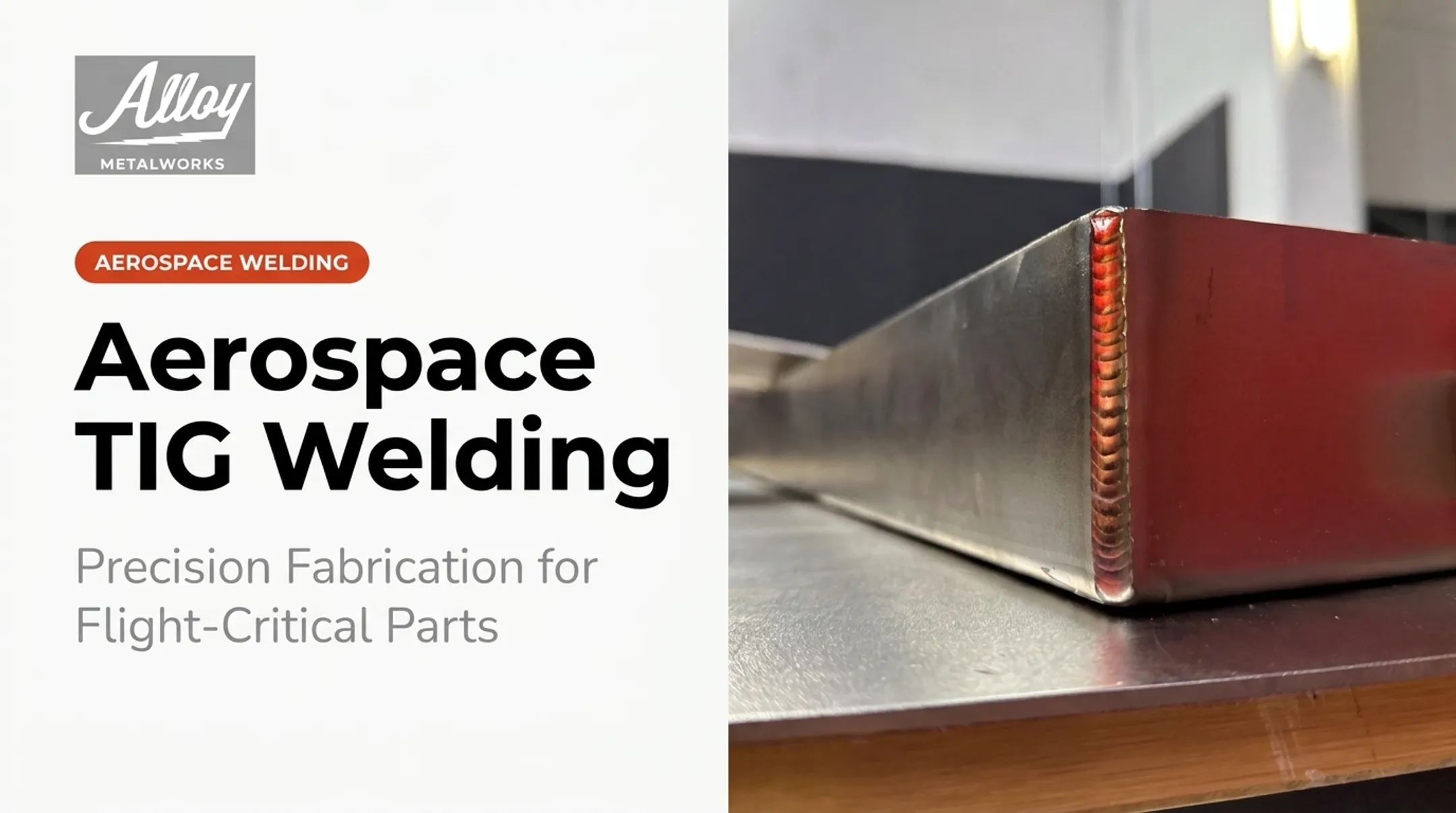
Take titanium welding as an example. Under AWS D17.1 Class A, purple and blue discoloration on a titanium weld visually fails inspection, even if the weld passes destructive mechanical testing or radiographic review. Visual contamination alone disqualifies flight-critical hardware. There's no partial credit.

This is why engineering collaboration matters long before a torch is lit. Design-for-manufacturability reviews, prototyping, and weld procedure development ensure a design translates into a flightworthy part rather than a rejected one.
At Alloy Metalworks, that means working directly with engineers and project managers before production starts on:
- Weld-joint design
- Heat-input and distortion control
- Contamination-risk mitigation
These steps happen up front, not after a part fails inspection.
What Products Does Aerospace Manufacturing Produce?
"Aerospace part" isn't a marketing term. It refers to any component engineered, tested, and certified to perform reliably under flight-critical or space-critical conditions.
Major product categories include:
- Airframes and structures — fuselage sections, brackets, structural weldments
- Engines — turbine components, combustion chambers, exhaust systems
- Avionics — housings and mounting hardware for navigation and control electronics
- Landing gear — high-strength stainless steel assemblies built for repeated impact loads
- Fuel systems — tubing, fittings, and tanks requiring leak-proof welds
- Ground support equipment — test rigs, fixtures, and handling structures
Why Materials Choice Matters
Parts range from tiny fasteners to large structural assemblies. Weight, strength, heat resistance, and corrosion performance drive material choice at every scale:
| Material | Why it's used |
|---|---|
| Titanium | Roughly 45% lighter than steel at comparable strength |
| Inconel/nickel alloys | Heat and corrosion resistance for engines and gas-turbine components |
| Aluminum | Low weight, mechanical stability, good temperature management |
| Stainless steel | High-strength grades used in landing gear, actuators, and flap tracks |
Alloy Metalworks works across this full materials range: Inconel 600, 601, 617, 625, and 718; titanium Grades 2 and 7; aluminum series 1000–7000; and stainless grades including 17-4, 15-5, and Duplex.
Typical aerospace fabrications include rocket and propulsion test systems, structural weldments, vacuum chambers, and custom frames and fixtures for thin-wall, lightweight structures.

Understanding the Aerospace Supply Chain
The industry runs on a tiered structure. Each tier plays a different role, and confusing them is a common mistake for teams new to aerospace sourcing.
What Is a Tier 2 Aerospace Supplier?
A Tier 2 aerospace supplier provides components, raw materials, and specialized fabrication—such as precision welding and machining—to Tier 1 companies, and sometimes directly to OEMs. The full chain breaks down like this:
- OEMs design and assemble the final aircraft, spacecraft, or defense system
- Tier 1 suppliers deliver major systems and subassemblies directly to OEMs
- Tier 2/3 suppliers feed Tier 1s (and sometimes OEMs) with parts, materials, and process work

There's no universally agreed number of Tier 2/3 suppliers feeding a typical OEM's chain. McKinsey's 2024 research highlights that supply-chain visibility drops sharply below the first tier, and that Tier 2/3 concentration is a growing risk factor OEMs are actively trying to map. Counts vary by program, subsystem, and how a company defines "supplier" in the first place.
What Do MRO and OEM Stand For?
- OEM (Original Equipment Manufacturer): the company that designs and builds the original aircraft or system
- MRO (Maintenance, Repair, and Overhaul): the aftermarket segment supporting aircraft and components throughout their service life
Many manufacturers, including certified repair stations, support both new-build and MRO work under the same quality system. That dual capability matters for procurement teams planning long-term part support, not just initial production runs.
Quality Standards and Certifications That Define Aerospace Manufacturers
Certifications keep flight-critical parts traceable and repeatable under defined process controls.
- AS9100/ISO 9001 — Baseline quality management expectation; AS9100D adds aviation, space, and defense requirements on top of ISO 9001:2015.
- FAA Part 145 Certified Repair Station — Authorizes maintenance, inspection, and alteration of aircraft and aircraft products under FAA oversight.
- AWS D17.1 — Governs fusion welding qualification, fabrication, and inspection for flight-critical hardware in aluminum, nickel, titanium, and related alloys.
- ASME Section IX — Covers welding, brazing, and fusing procedure qualifications.

Documentation enforces those standards in practice. First article inspection, weld procedure qualification records, and material certifications build an audit trail from finished part back to heat lot and welder.
Alloy Metalworks applies the same controls in daily work under ISO 9001 QMS, FAA Part 145 QMS, ASME Section IX, and AWS D17.1 Class A for flight-critical hardware, with AWS structural codes D1.1, D1.2, and D1.6 for broader fabrication.
How to Choose an Aerospace Manufacturing Partner
Not every fabrication shop that claims "aerospace experience" can actually deliver inspection-ready, flight-critical parts. Here's what separates the two:
- Engineering-aware collaboration — Look for a partner who supports the project from design concept through inspection-ready parts, not just someone who executes a drawing handed to them.
- Certifications that match the application — Verify AS9100, ISO 9001, and applicable welding codes directly against your part's requirements. Generic "we do aerospace" claims don't hold up under audit.
- Specialty alloy capability — Confirm real experience with Inconel, Incoloy, Hastelloy, and titanium. These materials behave differently under heat, and a shop without documented procedures for them will struggle.
- Turnaround and prototyping support — Startups and R&D teams often need small-batch runs and fast iteration, not just high-volume production capacity.
Alloy Metalworks, a Colorado-based precision welding and fabrication partner, works with aerospace, space technology, and advanced flight systems clients under ISO 9001-controlled processes and FAA Part 145 accreditation.
Welding is performed to AWS D17.1 Class A and ASME Section IX standards across exotic alloys including Inconel, titanium, and Hastelloy. Support ranges from prototype development to production optimization and process validation.
A quick gut check before signing on a supplier: ask to see their weld procedure qualification records for the exact alloy and thickness you need. If they can't produce them on request, that's your answer.
Frequently Asked Questions
What does aerospace manufacturing do?
Aerospace manufacturing covers the design, fabrication, assembly, and testing of aircraft, spacecraft, and defense systems under strict quality standards. Failure risk is high, so tolerances and inspection requirements exceed most other industries.
What products does aerospace manufacturing produce?
Major categories include airframes, engines, avionics, landing gear, fuel systems, and ground support equipment. Parts range from small fasteners to large structural assemblies.
What are aerospace parts?
Aerospace parts are components engineered, tested, and certified to perform under flight-critical or space-critical conditions—from brackets to full structural weldments.
What is a Tier 2 aerospace supplier?
A Tier 2 supplier builds components, materials, or subsystems for Tier 1 companies, and sometimes directly for OEMs. Work often includes precision welding, machining, or specialized materials fabrication.
What do MRO and OEM stand for?
OEM means Original Equipment Manufacturer—the company that designs and builds the original system. MRO means Maintenance, Repair, and Overhaul—the aftermarket work that keeps aircraft flying through their service life.