
That's the appeal driving adoption across aerospace, energy, and other regulated manufacturing sectors: tolerances keep tightening, and documentation requirements keep growing. A weld that's "good enough" doesn't survive an audit trail anymore.
This article covers how precision laser welding systems actually work, where they outperform traditional methods (and where they don't), material thickness limits, and what to look for in a fabrication partner.
Key Takeaways
- Focused laser beams produce narrow, deep welds with minimal heat-affected zones
- Match the method to the joint: conduction for thin cosmetic welds, keyhole for deep structural welds
- Aerospace, energy, and sanitary/pharma sectors rely on it for inspection-ready, code-compliant results
- Thickness capability ranges from under 1 mm to 20 mm+ depending on laser power and method
- A certified, engineering-aware fabrication partner cuts compliance risk and rework
How Precision Laser Welding Systems Work
The core mechanism is straightforward: a concentrated laser beam hits the seam, melts the material into a molten pool, and that pool resolidifies almost instantly as the beam moves on. No filler rod, no electrode, minimal contact with the part itself.
Conduction Welding vs. Keyhole Welding
Conduction mode melts the surface, and heat conducts downward from there. The result is a weld that's typically wider than it is deep. EWI notes this mode fits thin-wall material, spot welds, and applications where a clean, visible cosmetic seam matters more than raw penetration.
Keyhole mode uses higher power density to vaporize metal, creating a moving vapor tunnel that pulls the beam's energy deep into the joint. The weld comes out narrow and deep, with an aspect ratio often exceeding 1.5. The tradeoff: if that keyhole collapses mid-weld, you get porosity.
Choose the mode based on the joint:
- Conduction — thin wall, spot welds, cosmetic seams
- Keyhole — structural joints and deep-penetration work (for example, turbine components)

Types of Lasers Used
Fiber lasers have become the industry default, and the efficiency numbers explain why. According to IPG Photonics, fiber lasers convert roughly 40-57% of input energy into usable output. Compare that to older sources:
| Laser type | Typical wall-plug efficiency |
|---|---|
| Fiber | ~40–57% |
| CO₂ | ~7–8% |
| Lamp-pumped Nd:YAG | ~2% |
Most of the difference is heat loss. That gap shows up in operating cost and in beam stability over long production runs.

Stable output only helps if the beam stays on path. Robotic and CNC-integrated laser welding cells hold position and travel speed more consistently than a hand-held torch—critical once you are running hundreds of identical parts.
Key Benefits of Precision Laser Welding
Lower heat input, smaller heat-affected zone. Miller reports that on 18-gauge carbon steel, handheld laser welding puts roughly half the total heat into the part compared to TIG or MIG. Less heat means less distortion and better-preserved material properties.
Beyond heat control, other advantages include:
- Shortens cycle time on thin material through continuous travel and a small weld pool, especially when secondary finishing isn't needed
- Welds delicate or miniature components without electrode wear or mechanical stress
- Reduces post-processing (less oxide tint, spatter, and straightening), which offsets higher equipment cost over time
- Holds tighter tolerances across high-volume runs in automated cells than manual welding can
- Supports lightweighting by keeping distortion low, so designers can spec thinner material and still hit strength targets in aerospace and automotive work

Internal evaluation work at Alloy Metalworks confirms the same pattern on the shop floor: expanded options for thin or heat-sensitive materials, paired with higher travel speeds that hold up in production.
Precision Laser Welding vs. Traditional Welding Methods
| Factor | Laser Welding | MIG | TIG |
|---|---|---|---|
| Heat input | Low, focused | High, filler-heavy | Moderate |
| Weld speed | Fast on thin material | Fast on thick sections | Slower, manual |
| Precision tolerance | Very tight | Moderate | Tight, but operator-dependent |
| Best fit | Thin, heat-sensitive, appearance-critical parts | Thick, structural, wide-gap joints | Intricate joints, tight access |
Laser welding isn't a universal upgrade. MIG's filler deposition handles thick, structural, or wide-gap joints better. TIG still wins where manual control and tight access matter more than throughput.
There's also a forgiveness gap worth knowing about. Laser welding is less tolerant of setup error — minor fit-up, travel, or alignment deviations show up immediately in the weld.
A 2020 aerospace case study found autogenous laser welds typically need an air gap under 10% of material thickness, sometimes as tight as 0.15mm on a 3.2mm butt joint (Fabricating & Metalworking, 2020). TIG tolerates variable conditions far better.
Material Thickness and Capability Considerations
How thick can a laser weld go? There's no single answer, but the benchmarks are informative.
- Single-pass fiber laser: roughly 12-15mm on structural steel with a 16kW disk laser at 1.1-1.5 m/min; root humping and sagging are noted risks (Springer, 2020)
- Hybrid laser-arc: a 2024 study produced a sound single-pass on 20mm EH40 naval steel with a 15kW fiber laser at 1,500 mm/min (research result, not a production benchmark)
- Specialized multi-layer techniques: research has pushed past 60mm and even 120mm using groove welding and multiple passes

Material type changes the equation too. Reactive metals like titanium and Inconel need inert gas shielding to prevent contamination.
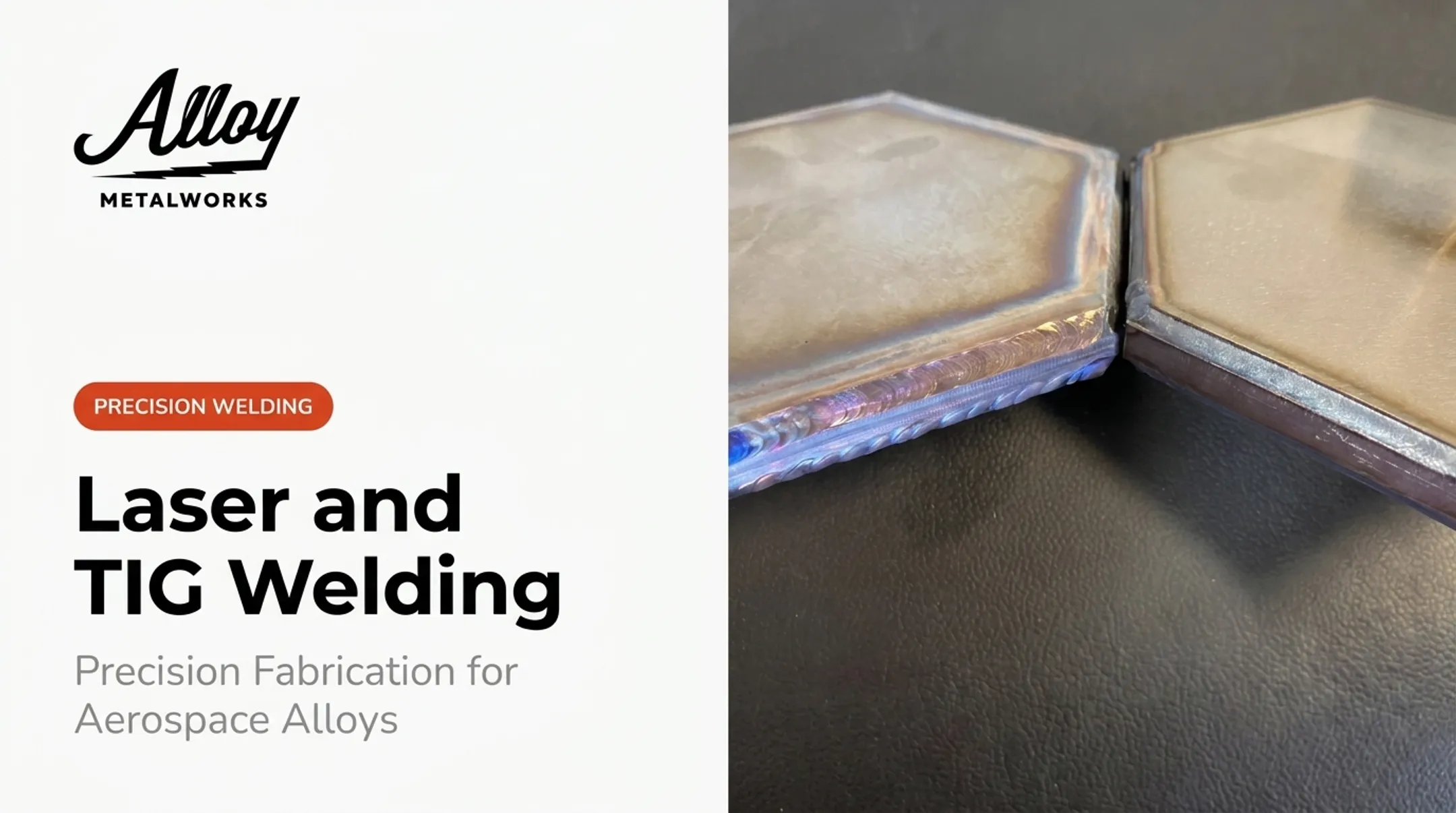
Titanium is especially unforgiving. At high temperature it readily absorbs oxygen, nitrogen, and hydrogen, and poor shielding shows up as visible discoloration.
That discoloration isn't cosmetic trivia. Under AWS D17.1 Class A, a titanium weld coupon with purple or blue tint gets rejected on visual inspection, full stop, because the color indicates atmospheric contamination that compromises the weld.
Industries and Applications That Rely on Precision Welding
Regulated industries turn to precision laser welding when joint quality, heat control, and documentation all have to hold up under scrutiny.
Aerospace and flight-critical hardware. AWS D17.1 governs fusion welding for aircraft and space hardware across aluminum, nickel, titanium, and other structural alloys, covering procedure qualification through inspection and repair. Traceability isn't optional here.
Energy systems. Hydrogen infrastructure, fuel cells, and thermal processing equipment use laser welding on high-performance alloys where speed and low heat input matter. TRUMPF, for example, applies remote laser welding to metallic bipolar plates in fuel-cell production for non-contact processing at production rates.

Sanitary and pharmaceutical systems. AWS D18.1 covers welding of austenitic stainless tube and pipe for hygienic service, with qualification, fabrication, and documentation requirements specific to food, beverage, and pharma processing.
Alloy Metalworks applies ASME Section IX and AWS-certified welding processes across aerospace, energy, and sanitary work, delivering inspection-ready, documented results where clients can't afford ambiguity in a weld record.
Choosing the Right Precision Welding Partner
Certifications aren't paperwork for their own sake. They're proof of a controlled process.
- ISO 9001 confirms a documented quality management system is in place
- ASME Section IX covers welding, brazing, and fusing qualifications
- AWS D17.1, D18.1, and structural codes confirm process qualification for aerospace, sanitary, and structural work respectively
None of these alone proves a specific laser parameter works for your part. What they do prove is that a shop has the documentation infrastructure to qualify, validate, and trace that parameter if asked.
Engineering-aware collaboration closes that gap. Alloy Metalworks works through weld procedure development, heat-input and distortion control, and process validation before welding starts—so problems surface on paper, not on the shop floor.
That approach applies across aerospace, energy, and research clients working with nickel-based superalloys, titanium, and other exotic alloys. A failed coupon means a delayed program, not just a scrapped part.
Before hiring a partner, request:
- The applicable code or standard for your part
- Current WPS/PQR documentation
- Personnel qualifications for the specific process and material
- Shielding and fit-up controls for reactive metals
- Inspection records and traceable test reports
Frequently Asked Questions
Do precision laser welders really work?
Yes. Aerospace, medical, and energy manufacturers use laser welding for precision, speed, and repeatability on thin and heat-sensitive materials.
How thick can a precision laser welder weld?
Single-pass fiber lasers typically handle up to about 5/8 in (15 mm) on structural steel. Hybrid laser-arc or multi-pass techniques can extend beyond 3/4 in (20 mm), depending on laser power and material.
What materials can be laser welded?
Common metals include stainless steel, aluminum, titanium, and nickel-based alloys like Inconel. Reflective metals such as copper require special handling, including absorptive coatings or blue-diode lasers.
Is laser welding stronger than TIG or MIG welding?
On thin materials, laser welding often matches or exceeds TIG/MIG strength thanks to lower heat input and reduced distortion. On thick sections, MIG's filler deposition typically performs better.
How much does a precision laser welding system cost?
Upfront investment runs higher than traditional welders, but reduced post-processing, faster cycle times, and lower rework often offset that cost over a production run.
What certifications should a laser welding provider have?
Look for ISO 9001, ASME Section IX, and applicable AWS codes (D17.1 for aerospace, D18.1 for sanitary applications). These indicate a documented, audit-ready quality system.